
Listening

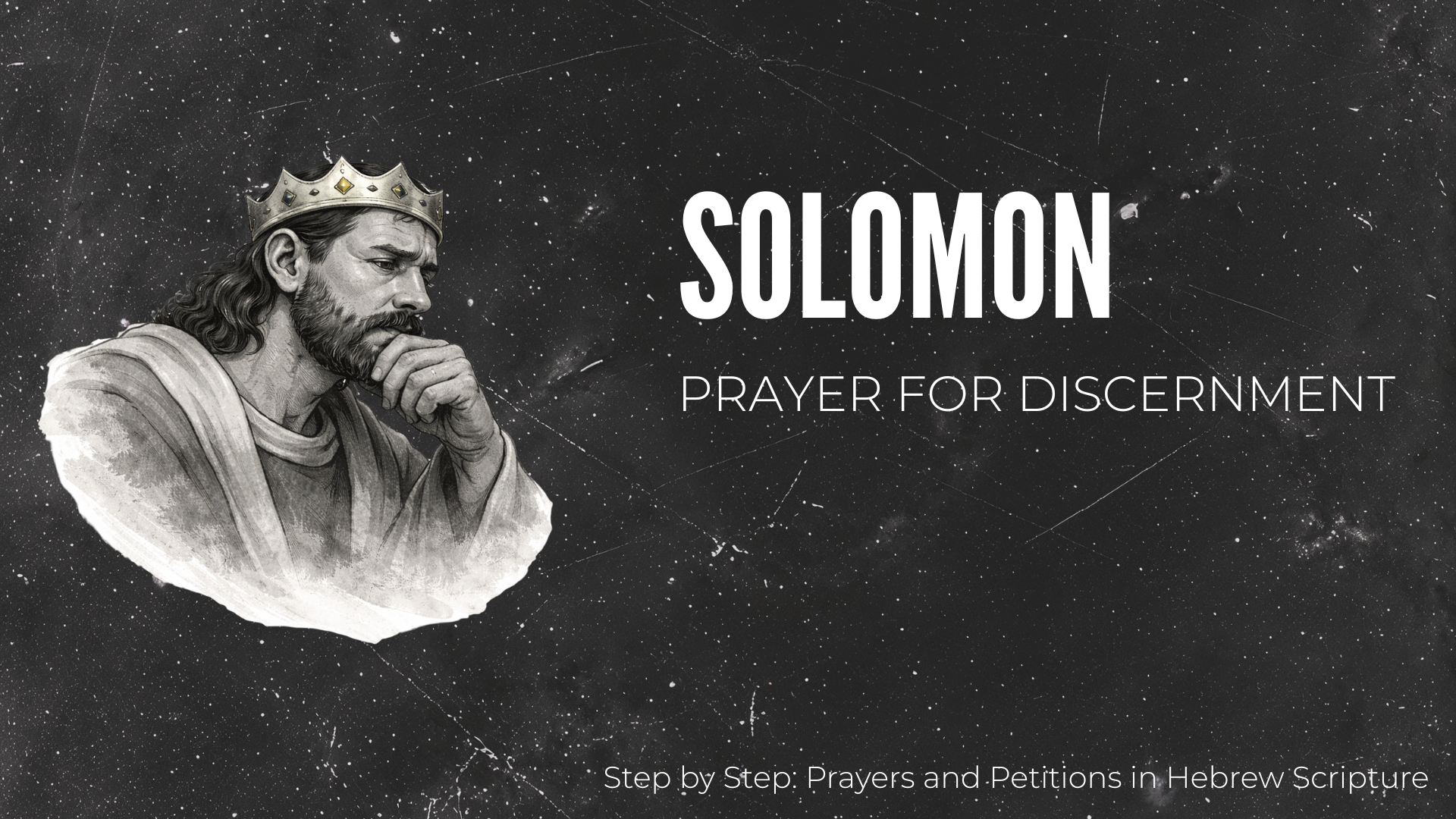
Solomon: Prayer for Discernment

Solomon: Prayer for Discernment
Pastor Cogan

1 Kings 3:4-14

The king went to Gibeon to sacrifice there, for that was the principal high place; Solomon used to offer a thousand burnt offerings on that altar. At Gibeon the Lord appeared to Solomon in a dream by night, and God said, “Ask what I should give you.” 

And Solomon said, “You have shown great and steadfast love to your servant my father David because he walked before you in faithfulness, in righteousness, and in uprightness of heart toward you, and you have kept for him this great and steadfast love and have given him a son to sit on his throne today. 

And now, O Lord my God, you have made your servant king in place of my father David, although I am only a little child; I do not know how to go out or come in. And your servant is in the midst of the people whom you have chosen, a great people so numerous they cannot be numbered or counted. 

Give your servant, therefore, an understanding mind to govern your people, able to discern between good and evil, for who can govern this great people of yours?”

It pleased the Lord that Solomon had asked this. God said to him, “Because you have asked this and have not asked for yourself long life or riches or for the life of your enemies but have asked for yourself understanding to discern what is right, I now do according to your word. Indeed, I give you a wise and discerning mind; no one like you has been before you, and no one like you shall arise after you. I give you also what you have not asked, both riches and honor all your life; no other king shall compare with you. 

If you will walk in my ways, keeping my statutes and my commandments, as your father David walked, then I will lengthen your life.”


Listen to your heart  when’s he’s calling for you. Listen to your heart, there’s nothing else you can do. I don’t know where you’re going and I don’t know why, but listen to your heart, before you tell him goodbye.
Yes, that’s Roxette’s 1988 power-ballad “Listen to Your Heart.” Be honest: how many of you wore out the cassette tape, belting it in the car? Songwriter Per Gessle says he wrote the tune after an all-night talk with his best friend whose marriage was crumbling. 

That pep-talk became a #1 hit, but here’s my problem with Per: catchy tune. Terrible advice; not only to his friend, but to the millions of people who listen to that song and think, “that’s how I’ll know what to do, I just need to listen to my heart.” 

The sentiment has become the go-to cliché for discernment. The motto sounds innocent enough, but its implications are anything but. “Listening to your heart” is really code for turning inward—figuring out what you want, what you think you need—and letting that be the deciding factor. 

We say it all the time in different ways: To the student choosing a major, study what makes you happy. 

To the friend considering a relationship, be with the one who makes you happy. To anyone eyeing a new city or job, go where you’ll be happy. With this Roxette wisdom, the most important person in the equation is you, and the measure of a good choice is whatever benefits you most. 

After all, as the song says, “there’s nothing else you can do.”

Except there is. Because sooner or later we realize that turning inward pulls us in a dozen directions. 

We don’t really know what we want; we misjudge what will make us happy—and we end up right back where we started, unsure what to do next. 

That’s the crossroads where Solomon stood, and his prayer flips the slogan on its head: discernment isn’t listening to your heart; it’s asking God for a listening heart, one attuned to God and to the people around you.

That request, a listening heart, is the heartbeat of this prayer. But notice how it starts. God says to the brand-new king, “Ask me for what I should give you.” Translation: Anything you want, Solomon - name it. Solomon responds with a little speech about how great God is and how faithful God was to his father David. 

It sounds a bit like a child buttering up a parent before the big ask: “Mom, you’re the best mom; can I have candy for breakfast?”

Solomon even calls himself “a little child who doesn’t know how to go out or come in.” Meaning, he has zero military experience; he doesn’t know how to lead an army out or bring one home—let alone guide a nation. That honesty is ironic, given how Solomon reached the throne.  

He wasn’t ushered in by popular acclaim like his father David; others were ahead of him. With some help, he muscled his way in, banishing rivals to far-off places, arranging a few convenient deaths. He rose less like an anointed king and more like a mafia boss. Now he admits he’s in over his head.

Solomon fought hard to reach the throne, only to realize he suddenly doesn’t know what to do. He could have made a candy-for-breakfast request—asking for the things kings usually crave: a long life, a larger kingdom, protection from rival nations. Had he turned inward and listened to his own heart, that’s likely what he would have asked for. But he doesn’t. Instead, he owns up to his limits and asks for help: “Give your servant an understanding mind to govern your people, able to discern between good and evil, for who can govern this great people of yours?” 

Understanding mind doesn’t quite get at the depth of the Hebrew. Solomon is literally asking for a listening heart. In the Old Testament world, the heart was the decision-making center where thought and passion met. Notice he isn’t asking for a good heart, but a listening one: attentive to the petitions of the people he now leads, tuned to God’s voice, able to choose between good and evil—between what brings life and what brings death.

This request almost seems surprising to God, who expected riches and long life and the death of enemies. But because Solomon did not ask for any of that, God gives the new king not only what he asked for, but also the very things he didn’t.

This is not a story telling us that if we butter God up just right and ask for the perfect thing, God will give it to us and then some. Rather, what I hope you see is that we have all been in something like Solomon’s position. Sure, you haven’t acted like the Godfather to get what you want—or at least I hope not. 

But all of us have found ourselves in a situation where others need us, depend on us, and we don’t know what to do. Maybe it’s something you’ve always wanted, something you’ve envisioned a thousand times, but once you finally arrived, you realized you had no idea what you were doing. Or perhaps you were thrust into a position you never wanted, and suddenly people are looking to you for help.

It’s the newly married couple with no idea what they’ve gotten themselves into. The new father who is overwhelmed with parenting. The person who just got a promotion—or a divorce, or a diagnosis, or a diploma—but has no idea what to do next.

What Solomon shows us is that rather than listen to your heart, we ask God for a listening heart: one that opens us to the needs of those around us, makes us aware of how our decisions affect others, and leads us to choose what brings life, not just for ourselves, but for all people. 

That’s true discernment. 

And that’s the prayer we carry with us tonight: God, give me a listening heart. In my home, in my work, in every place where others are depending on me. In those moments when I feel over my head and don’t know what to do, teach me to listen to you, and to those around me, so that what I choose leads to life.

Amen.


Not So Golden Silence

Not So Golden Silence
Pastor Cogan

John 14:8-7

Philip said to him, “Lord, show us the Father, and we will be satisfied.” Jesus said to him, “Have I been with you all this time, Philip, and you still do not know me? Whoever has seen me has seen the Father. How can you say, ‘Show us the Father’? Do you not believe that I am in the Father and the Father is in me? The words that I say to you I do not speak on my own, but the Father who dwells in me does his works.

Believe me that I am in the Father and the Father is in me, but if you do not, then believe because of the works themselves. Very truly, I tell you, the one who believes in me will also do the works that I do and, in fact, will do greater works than these, because I am going to the Father.

I will do whatever you ask in my name, so that the Father may be glorified in the Son. If in my name you ask me for anything, I will do it. “If you love me, you will keep my commandments. And I will ask the Father, and he will give you another Advocate, to be with you forever. This is the Spirit of truth, whom the world cannot receive because it neither sees him nor knows him. You know him because he abides with you, and he will be in you.


Speech is silver. Silence is golden. That’s the full proverb, not just the part we usually hear. It implies it’s better to listen than to speak, and often I agree. But what about when those three little dots appear on your phone screen—and then vanish? How do we feel then? When you call someone and it goes straight to voicemail? When an email notification reminds you it’s been seven days with no reply? You submit a job application and never hear back.

They promised to call, but the phone stays silent. The calendar pages keep flipping, and you lose track of how many months it’s been since you last heard from your son or daughter, mother or father, family member, or once-close friend. Silence then isn’t golden. When communication stops, the silence isn’t just deafening; it’s devastating. Because we often take silence—an unreturned call, a job application ignored, a text unread—as judgment.

Instead of considering someone might be busy, distracted, or forgot their vacation responder, we assume they changed their mind about us or we offended them. Silence is rarely taken at face value. We struggle with silence because, as humans, we’re wired for communication. It’s how we connect and form bonds. When that connection is cut off, when we are ghosted, (or when we do the ghosting you know who you are) it causes confusion, lack of closure, even discontent. And we don’t function as we should.

Take, for instance, the silent treatment. We’ve all done it. We’ve all been on the receiving end of it. That is silence as punishment. Kipling Williams, emeritus professor of psychological sciences at Purdue University, has studied its effects for over 30 years. The silent treatment is a common tactic in all kinds of relationships: friendships, marriages, family bonds, coworkers—you name it.

Why do we do it? Some say it feels satisfying—like gaining control or making a point.

But psychologists warn it can cause lasting harm. One leading psychiatrist says that for those shut out, intentional silence triggers “anxiety, fear, and feelings of abandonment,”. It often leads to self-doubt, self-blame, and self-criticism.

Worse than that, silence hurts—literally. Purdue’s Dr. Williams found being ignored activates the same brain areas as physical pain. “It’s not just metaphorically painful,” he said, “the brain detects it as pain.” Silence can indeed be violence—or worse, deadly.

I wonder if the disciples felt like they were getting the silent treatment from Jesus. At the end of Luke’s Gospel, the last thing Jesus said to his disciples was, “Stay in the city until you have received power from on high.” In the first chapter of Acts, which continues Luke’s story, Jesus tells them just before his ascension, “You will be baptized with the Holy Spirit not many days from now.” So in Jerusalem, they went back and forth from the temple to where they were staying, praying continually and waiting for the Holy Spirit to come—whatever that would look like.

The first day passed—no big deal.

Day two, more prayers—still nothing.

By day three, their hopes were up—a lot can happen in three days, they told themselves. But again, nothing.

I wonder if the disciples, as they waited for this Holy Ghost, felt like they might have been ghosted? Hours became days, days became a week—and still no sign of the Holy Spirit.

Surely you know how this feels. Is there anyone who hasn’t waited for God to reply to their prayers? To make good on a promise you feel God has made to you, like not forsaking you, or comforting you, healing you, or simply helping you? Anything would be nice—even a no! But instead, you get silence. And just like with people, we take that silence to mean we’ve done something wrong and God is mad, or God doesn’t care, or there is no God at all.

I wonder if on the ninth night after Jesus ascended and promised to send the Holy Spirit, but had yet done nothing, those same thoughts crept into the farthest reaches of the disciples’ minds. But undoubtedly, some of you are thinking: Ten days? I’ve been waiting ten years, twenty years, or more to hear from God—and I’m still waiting today! Talk about the silent treatment—that hurts.

But on the morning of that tenth day, as the disciples were all sitting together in one place— the waiting gave way to a wind. Suddenly a sound like a rushing, gusting wind filled the house. Then tongues, cut in half down the middle, maybe engulfed in flame but not burning—like the bush from Moses—dropped from heaven and landed on each of them. Somehow, the tongues were the bearers of the Holy Spirit that then filled the disciples and allowed them to speak in other languages.

And you know the rest of the story from there. Jews from all around the world understood the disciples. Peter gave a sermon. Nearly 3,000 were baptized that very day.

I think Pentecost has a lot to teach us about the silence we face in this life—both from God and from others.

First, your answer or response from God might—perhaps is even likely—to come in ways you never could have imagined. I’m sure divided tongues of fire weren’t on any of the disciples’ bingo cards for how Jesus would make good on his promise to give the Holy Spirit.

I can’t imagine how frustrating and painful it is—or has been—for those of you who feel like God has altogether forgotten your prayers, your concerns, or simply you. But Pentecost gives us hope—maybe gives you hope—that whatever it is you’re waiting for will come, just in a way you never anticipated. William Cowper, the 18th-century poet, has it right: God moves in a mysterious way.

Second, being in and among a community helps. It helps with discernment and hope. Pentecost wasn’t an individual experience, but a communal one. Everyone had been praying together. Everyone had been waiting together. God moves in a mysterious way, yes; but God also often works in the midst of community. That’s why we, as a community, gather for worship, prayer, fellowship, and more—to help one another in discernment, to offer hope when someone has all but run out, to be the person God is at work through for the other. And if you don’t have that kind of community, I hope Cross of Grace can be that place, that people for you, with you.

Lastly, if the Holy Spirit was able to give words and understanding to people from all over the world on that Pentecost, surely the Holy Spirit can do the same in this time and place. How many of us are experiencing silence with someone we love because we don’t know what to say?

Maybe it’s about politics, or a fight you got into, or a mistake that was made, and you haven’t approached them because you don’t think you have the right words, or you don’t know what to say, or they won’t understand no matter what.

I think that is a dominant feeling for nearly everyone in our culture today. But one thing research tells us is that the silent treatment doesn’t work—and one thing our faith tells us is that the Holy Spirit can do the impossible, like people from Galilee speaking languages from all across the world.

We need a Pentecost today. We need the Holy Spirit to give us words that transcend differences, that repair what has been broken, that grow a community. At a time when we are so dangerously and direly divided, when there is so much pain and misunderstanding, we need the ability to not only speak, but perhaps even more so the ability to understand one another.

Henri Nouwen says, “One of the main tasks of theology [and I would also say of the church] is to find words that do not divide but unite, that do not create conflict but unity, that do not hurt but heal.”

In the days ahead, Reach out to someone with whom you are experiencing silence.

Send a text, make a call, and simply say, ‘I’m thinking of you.’ Let the Spirit move through your words and actions.

In your prayers, lament and be honest with yourself and with God about the silence and pain you’ve experienced from God. And then ask God to work, move, do something! The Psalms, the prophets, even Jesus himself do all of these things, so you’ll be in good company.

Look for moments to listen deeply this week—to a friend, a family member, or someone you normally might not hear. Maybe that's at our Christian Nationalism class or a family gathering or even a different news channel than you normally listen to.

Pentecost is about listening/understanding as much as speaking. These small steps are ways we can practice living in the Spirit’s power now because, we don’t need any more silence, no matter how golden, nor the pain that comes with it.

We need a Pentecost, to break the silence and build community. Come Holy Ghost.

Amen.