Matthew 5:13-20
[Jesus said,] “You are the salt of the earth. But if salt has lost its taste, how can it’s saltiness be restored? It is no longer good for anything, and is thrown out and trampled underfoot. You are the light of the world. A city built on a hill can not be hid. No one lights a lamp and puts it under a bushel basket, but places it on the lampstand where it gives light to all in the house. Let your light shine before others, therefore, so that they might see your good works and give glory to your father in heaven.
“Do not think that I have come to abolish the law and the prophets, for I have not come to abolish, but to fulfill. For truly I tell you, until heaven and earth pass away, not one letter – not one stroke of a letter – will pass from the law until all is accomplished. Therefore, whoever breaks one of the least of these commandments and teaches others to do the same, will be called least in the kingdom of heaven. And whoever does them and teaches them, will be called great in the kingdom of heaven. For truly I tell you, unless your righteousness exceeds that of the scribes and pharisees, you will never enter the kingdom of heaven.”
I got to spend a couple of days this week at the annual reunion of the Wabash Pastoral Leadership Program, in Crawfordsville, which is always a real boon for my spirit and sense of call, and reminder of why church work and ministry matters so much in the world, these days – and the impact we can have when we get it right.
For those of you who don’t know/remember, the Wabash Pastoral Leadership Program is a Lilly Endowment-funded endeavor that gathers small groups of Christian clergy from around Indiana for a two-year program of study, learning, and travel, that connects pastors with each other and with civic leaders from around the state to broaden the scope of what congregations can accomplish in the world, in whatever context they find themselves. For those of you who’ve been around awhile, you might remember that I was part of the first cohort of the program back in 2009-2010. (I would spend a few days, every other month at Wabash College and take a couple of international trips thanks to the program.)
Anyway, the program hosts annual reunions for the pastors who’ve engaged it over the years, and that’s where I was for about 48 hours last week. As part of it all, some of our colleagues shared, with the rest of us, some of the work they’ve been up to in their various settings and communities.
A couple of pastors in New Albany teamed up the past couple of summers to establish a ministry of “cooling stations,” hosted by a handful of churches in their town … places where house-less people and families – rather than hiding in the public library or wading in the creek on the edge of town to keep cool – could find air-conditioned shelter, safety, and water when the temperatures reach 100 degrees or more. This is what kingdom welcome and hospitality looks like – on earth as it is in heaven.
Another pastor’s congregation does the opposite. Over at West Morris Free Methodist Church on the westside of Indy, they have a very traditional 60,000 square foot building with a sanctuary that seats close to 1,000 people, though they only worship about 40, these days. So, they removed all of their empty wooden pews, filled their space with tents, and house nearly 80-100 house-less people when temperatures are too dangerously cold to sleep outside. What used to look like this:
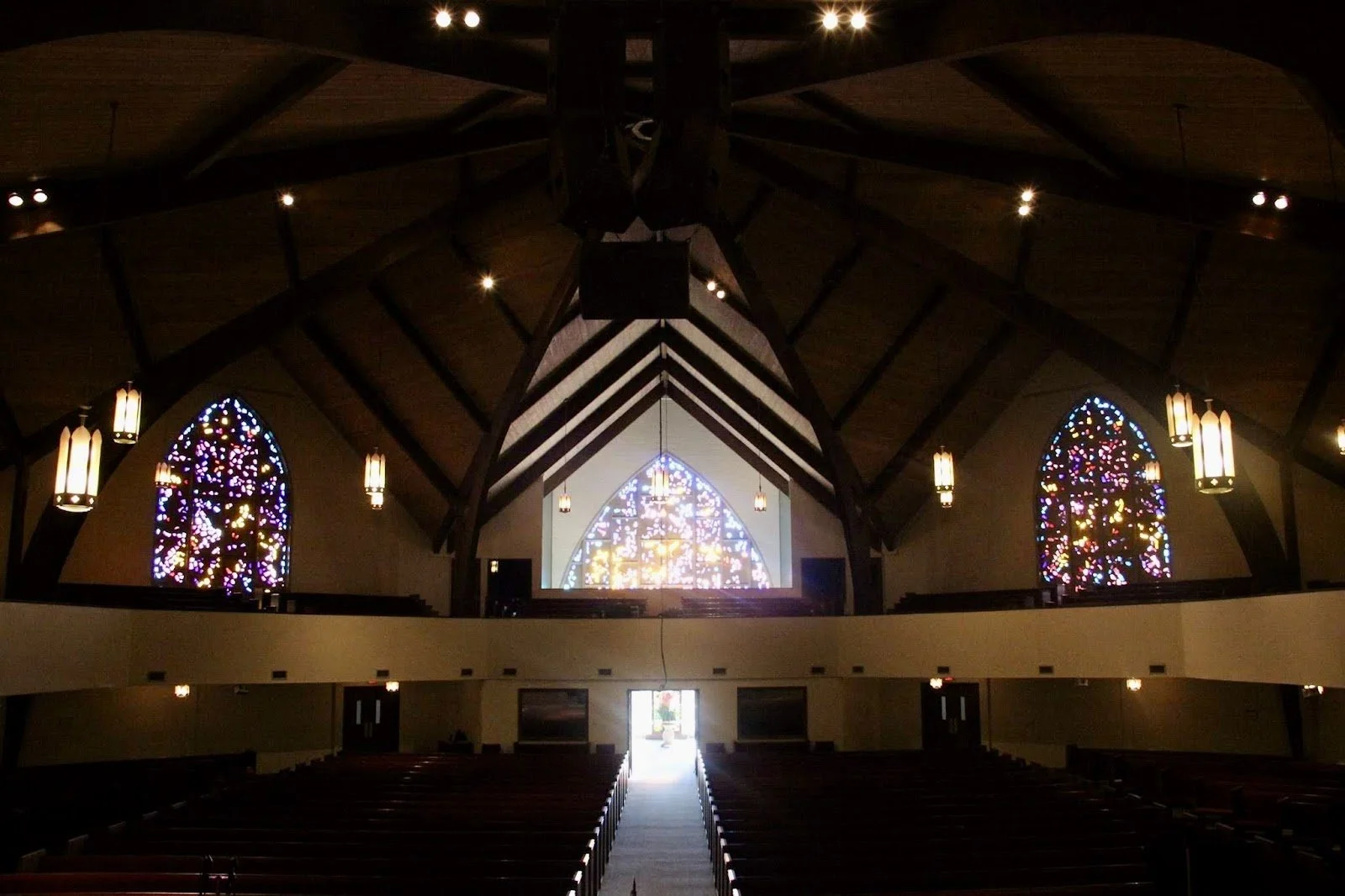
now looks like this:
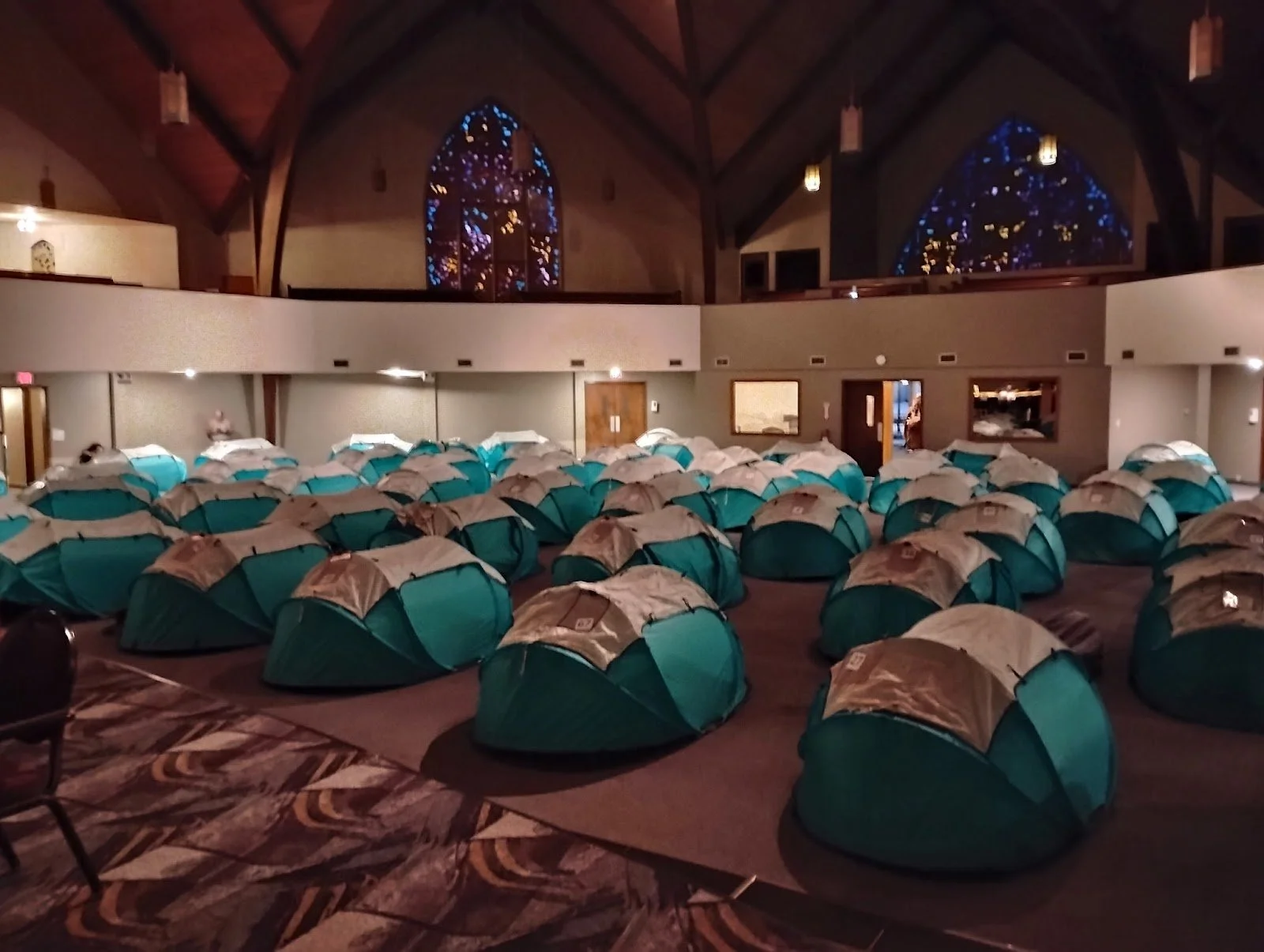
Of course, they feed them and care for them in other ways, too. It’s still very obviously a sanctuary, maybe more now than ever before, and this is what the fullness of the kingdom tastes like when we get it right.
A friend from my own cohort – Kent Ellet, the Pastor at the Speedway Church of Christ and his congregation – have bought and rehabbed three houses in recent years on Alton Avenue, near their church. They’re working on their fourth, as we speak. Once they are ready, they rent these houses at half the cost – or less – to individuals and families who need stable housing and other support, in order to get back on their feet after all manner of struggle, difficulty, bad luck, and whatnot. My friend Kent calls this ministry the “Alton Alternative” and it is a light of grace, sitting high on a lampstand, shining brightly for all in those houses – and their surrounding neighborhood, and now all of us – to see.
When Jesus tells the crowds on the hillside in this morning’s Gospel that they are the salt of the earth and the light of the world, he was trying to get them to think differently about the kind of light and flavor their faith brings to the world around them. And, I happen to think, he was inviting them to get creative about that for a change … to wonder differently about what kind of difference they might make … to imagine ways their faith was inviting them to be a blessing for the world.
“You are the salt of the earth,” he tells them. “But if salt has lost its taste – if you have lost your flavor – what good is that? What are you doing here? What’s the point of it all?”
“You are the light of the world,” Jesus says. “Like a city on a hill… like a lamp on a stand… like a beacon in the night. Don’t cover yourselves up… don’t hide under a basket. Let your light shine so others can see what you’re up to; so people know what God is doing through you… and for you… and for the sake of others.”
Now, I happen to think we have so much to be glad about and plenty to celebrate and even a little to be proud of when it comes to how we do Church here, in this place, especially when I think of the very unique voice Cross of Grace is in our community.
No one else is welcoming, advocating for, and hosting events that support our LGBTQ+ friends, family, and neighbors. No one else is preaching and teaching and hosting ministry that supports anti-racism and racial justice the way we do.
We have $45,000 to give away from our Building and Outreach Fund grants thanks to our generosity over the course of the last year. (Please spread the word to your favorite non-profit organizations to apply for those grants before the end of March.)
And I hope, as we continue to wonder about this building project that’s on the horizon we’ll get creative about all of this salt and light stuff in ways my Wabash friends have done.
And just to get your wheels spinning, you should know I have started a conversation with our schools about a reading program for kids in our area for whom English isn’t their primary language. For those of you who know about the HOSTS program that already exists in our elementary schools, imagine that but for immigrant kids who speak Spanish or Haitian Creole. (I just learned we are blessed to have literally hundreds of them in our school district.)
Pastor Cogan has ideas about Cross of Grace hosting a summer day camp for kids who can’t afford the kinds of camps many of us send our kids to when they’re not in school.
Maybe we could be a cooling center … or a warming station … or let our parking lot be a safe place for people living in their cars to park for the night.
We could certainly host more and bigger special events for places like The Landing.
We could host more 12 Step meetings; expand our food pantry operations; you get the idea …
All of this is about not getting bored – or becoming boring – or losing our flavor – or letting our light dim – or hiding it under a bushel basket of complacency or apathy or selfishness or comfort or safety or whatever tempts too many Christians to stop doing God’s bidding.
All of this is about being as inspired as we are unsettled by those words from the prophet Isaiah this morning – words that surely inspired and unsettled Jesus, too… all of that stuff about loosing the bonds of injustice; about letting the oppressed go free; about sharing bread with the hungry; bringing the homeless poor into our house; covering the naked, and all the rest.
So let’s pray about and plan a future together, full of hope about the ways we can salt the earth and light up the world – with all that Isaiah promised and all that Jesus embodies:
hope that our light – that the light of God – will break forth like the dawn;
hope that our healing – that the healing of humanity – will spring up quickly;
hope that our vindicator will go before us, and the glory of the Lord will have our back;
hope that we will call and God will answer;
hope that our needs will be satisfied even in parched places;
Let’s be hopeful – and full of faith – that, as God’s people, we will be known and seen and received, like a spring of water for the thirsty, like rebuilt ruins for those in need of refuge, like a firm foundation for those who can’t stand on their own; like a repairer of the breach for the broken among us, and like a restorer of streets to live in for a world searching for home.
Amen
