
Mark 1:14-20
Now after John was arrested, Jesus came to Galilee, proclaiming the good news of God, and saying, “The time is fulfilled, and the kingdom of God has come near; repent, and believe in the good news.”
As Jesus passed along the Sea of Galilee, he saw Simon and his brother Andrew casting a net into the sea – for they were fishermen. And Jesus said to them, “Follow me and I will make you fish for people.” Immediately, they left their nets and followed him. As he went a little farther, he saw James, son of Zebedee and his brother John, who were in their boat mending the nets. Immediately he called to them; and they left their father Zebedee in the boat with the hired men, and followed him.
It's important to realize, first, that we are still in the first chapter of Mark’s Gospel, only at the 14th verse. It matters because Mark is a man of few words, so every one of them matters. His Gospel is the shortest, sweetest of them all. He gets right to the point all along the way, and says a lot with very few details to gum up the works.
Just in the first dozen or so verses of his version of Jesus’ life story, Mark’s gospel has John the Baptist warning everyone that Jesus is on the way. He has Jesus baptized, by John, in the Jordan. He mentions, with one little verse, that Jesus was driven into the wilderness to be tempted by the devil. And this morning, at verse 14, we’re told that John the Baptist has been arrested, and that Jesus has come to Galilee proclaiming the Good News.
Then he walks along the lakeside calling his first disciples who, without question or confusion – without hesitation or halting – drop what they’re doing, leave their friends and families, leave their co-workers and careers, and begin to follow Jesus to God-knows-where. I don’t imagine these first disciples – Simon, Andrew, James and John – were Lutherans.
As a life-long Lutheran, I can say that. I can say, too, with some confidence that they weren’t Presbyterians or Roman Catholics or Methodists or Episcopalians, either. And I don’t make that assumption simply because such flavors of Christ-followers didn’t exist yet, in Jesus’ day. I say it because, in this day and age, we are much more careful and considered when it comes to following Jesus. Most people I know are not “drop your nets, leave your family, quit your job, no-questions-asked” sorts of followers. We want to know where we’re headed; what the risks are; what the return on our investment might be; who else is going to be there; and just exactly what this ‘fishing expedition’ is going to entail.
But I can say, from my own limited experiences, that our way of following doesn’t always lead to the most fun, meaningful, life-changing, faith-building experiences. On the contrary, I’ve found that when I plan less and pray more; when I don’t ask as many questions and demand even fewer answers; when I leave my proverbial nets behind and take my chances on God’s gracious provision, that I do a better job of responding to what God might have in mind for me in the first place. And I notice God’s presence and power in more surprising ways than I would otherwise.
And this happened for me – or to me – or through me – or whatever – over the course of the last couple of weeks, during my time in Kenya, where I was part of a small team that taught the Bethel Bible Series curriculum to a group of about 130 African pastors over the course of a week.
My invitation to all of that didn’t come by way of Jesus on the beach. It came by way of a form letter, from the director of the Bethel Series, asking for help raising money for a trip that was already planned and in the works. Without much thought, and with even fewer expectations, I shot off an e-mail, asking how one might get into the mix of such an event in the future, sometime down the road a ways. A response came quickly and I was told that the trip at hand only had three teachers, that four would be better, and that I’d be a welcome addition to the team, if I was interested.
After a brief conversation with Christa – who usually has many more questions and concerns and reservations about this sort of thing than the rest of us, combined – we agreed I should throw my net into this water, if you will – and commit to being part of this opportunity. And that was that. It was the middle of SEPTEMBER. The trip would be in JANUARY. Advent and Christmas were on the way. A family vacation had already been scheduled for the week before I would leave. I didn’t have a clue about who I would be teaching, really; with whom; or what, exactly, either.
I’d never been to Africa. I didn’t know a thing about Kenya. I had no idea where the city of Kisumu was. And the closer I got to my departure, when the crazy, busy distractions of Christmas were over, when our vacation ended and the reality of what I’d signed up for loomed, I realized I was much more anxious than I’d let myself admit.
For starters, it seemed harder, this time around, to leave Christa and the boys and to fly to the other side of the world, than it has been in the past. I knew I’d be missing some important things around here while I was away. I worried, too, about how my kind of teaching would connect with people and pastors – from varying denominations, background and lifestyles – who I’d never met before. And there are always the concerns and worries about food and accommodations and safety that come with international travel, too.
My point here, though, is that it all ended well. Better then well. I learned as much for and about myself as anything I was able to teach all those Kenyan pastors. But I did teach them a thing or two, from what I could tell, and I look forward to going back for a second round of it all in 2019.
But this isn’t all about me. My little international teaching and travel experiences are like “Discipleship Lite” in comparison to the story of Maurice Odhiambo,
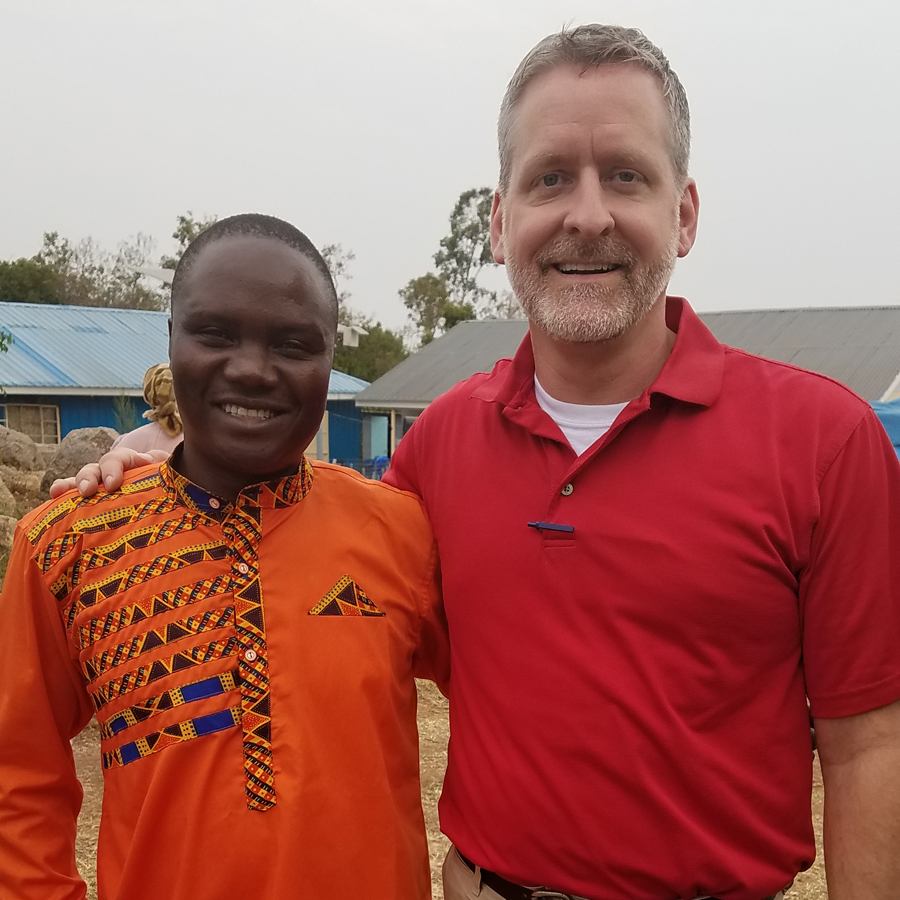
the Kenyan pastor who directs “Manna Missions,” the organization that brought me to Kisumu and who organized the pastors and the teaching and all that I was able to do there.
Maurice grew up in the slums of Nairobi. I didn’t get to see them because we weren’t in Nairobi very long and because, I was told, we’d need armed guards to accompany us for a visit. I think they are just as you might imagine them to be…maybe worse, in terms of sanitation, safety, and a sense of despair that must weigh heavy in a place like that.

Now, I don’t know his whole story, but Maurice runs a publishing company and is the director, like I said, of “Manna Missions,” which responds in as literal and as faithful a way as I know to the Biblical command – which belongs to all of us – to care for the widow and the orphan. Under his leadership and by way of his faithful following, he provides food, water, healthcare, education, companionship, spiritual direction and the love of God to widows, children and orphans in his little corner of God’s kingdom on earth.
And it takes a lot to surprise me anymore, as I think many of you know. But I was blown away to learn that in Kisumu, in 2018, widows are treated – still – the way we read about widows having been treated in the days of Jesus. I mean they are ostracized, neglected, married off against their will, considered unclean and unwanted and untouchable and undeserving of care and compassion in ways I wouldn’t have believed if I hadn’t seen it for myself.

(This is Grace, a widow whose own children are trying to take the land on which she lives, because it is of more value to them than she is.)
Among other things, it is not uncommon for a widow to die, alone in her home, and only be discovered when a passerby smells something from the road.
All of that to say, Maurice Odhiambo has responded to God’s call on his life to do ministry for and with widows in his hometown. Following Jesus, for Maurice and for his Partners in Mission, means challenging cultural norms that say widows are unclean. Following Jesus, for Maurice, means confronting superstitions that promise death to those who help these widows by caring for their houses, bringing them food, praying for or visiting with or providing medical care to them when they need it. Following Jesus, for Maurice, means leaving more than just his nets in a boat in order to walk in the ways of his Savior.
So when I read about Jesus’ invitation to follow him and to fish for people – on the heels of my own experiences with Maurice and my new friends in Kenya – I am as convicted by my own small-mindedness about what that could and should look like, as I am challenged and inspired by what God could do with me – and with the rest of us – when we respond to that invitation in more faithful, more fearless ways.
It’s too soon to know exactly what I’m getting at where Kenya is concerned, I’ll be honest. But I hope you’ll join me in praying and dreaming, in this new year, about what God will do in and through and for us in the days to come; what God will do when we realize and live like the Kingdom of God has, indeed, come very near; when we believe in the Good News of Jesus Christ; and when leave behind whatever is required in order to follow him with faith, in spite of our fear, for the sake of the world.
Amen
