John 3:1-17
Now there was a Pharisee named Nicodemus, a leader of the Jews, who came to Jesus by night and said to him, “Rabbi, we know that you are a teacher who has come from God because no one can do the signs that you do apart from the presence of God.” Jesus answered him, “Very truly I tell you, no one can enter the Kingdom of God without being born from above.” Nicodemus said, “How can one be born after having grown old? Can one enter a second time into the mother’s womb and be born?”
Jesus answered him, “Very truly I tell you, no one can see the Kingdom of God without being born of water and Spirit. What is born of the flesh is flesh and what is born of the Spirit is Spirit. Do not be astonished that I’ve said to you, ‘You must be born from above.’ The wind blows where it chooses and you hear the sound of it, but you do not know where it comes from or where it goes. So it with everyone who is born of the Spirit.” Nicodemus said to him, “How can these things be?”
Jesus answered him, “Are you a teacher of Israel and yet you do not understand these things? Very truly I tell you, we speak about what we know and we testify to what we have seen and yet, you do not receive our testimony. If we speak to you about earthly things and you do not believe, how can you believe when we tell you about heavenly things?
“No one has ascended to heaven except the one who descended from heaven, the son of Man. And just as Moses lifted up a serpent in the wilderness, so must the Son of Man be lifted up so that everyone who believes in him may have eternal life.
“For God so loved the world that he gave his only son so that everyone who believes in him may not perish, but may have eternal life. Indeed, God did not send the Son into the world to condemn the world, but in order that the world might be saved through him.”
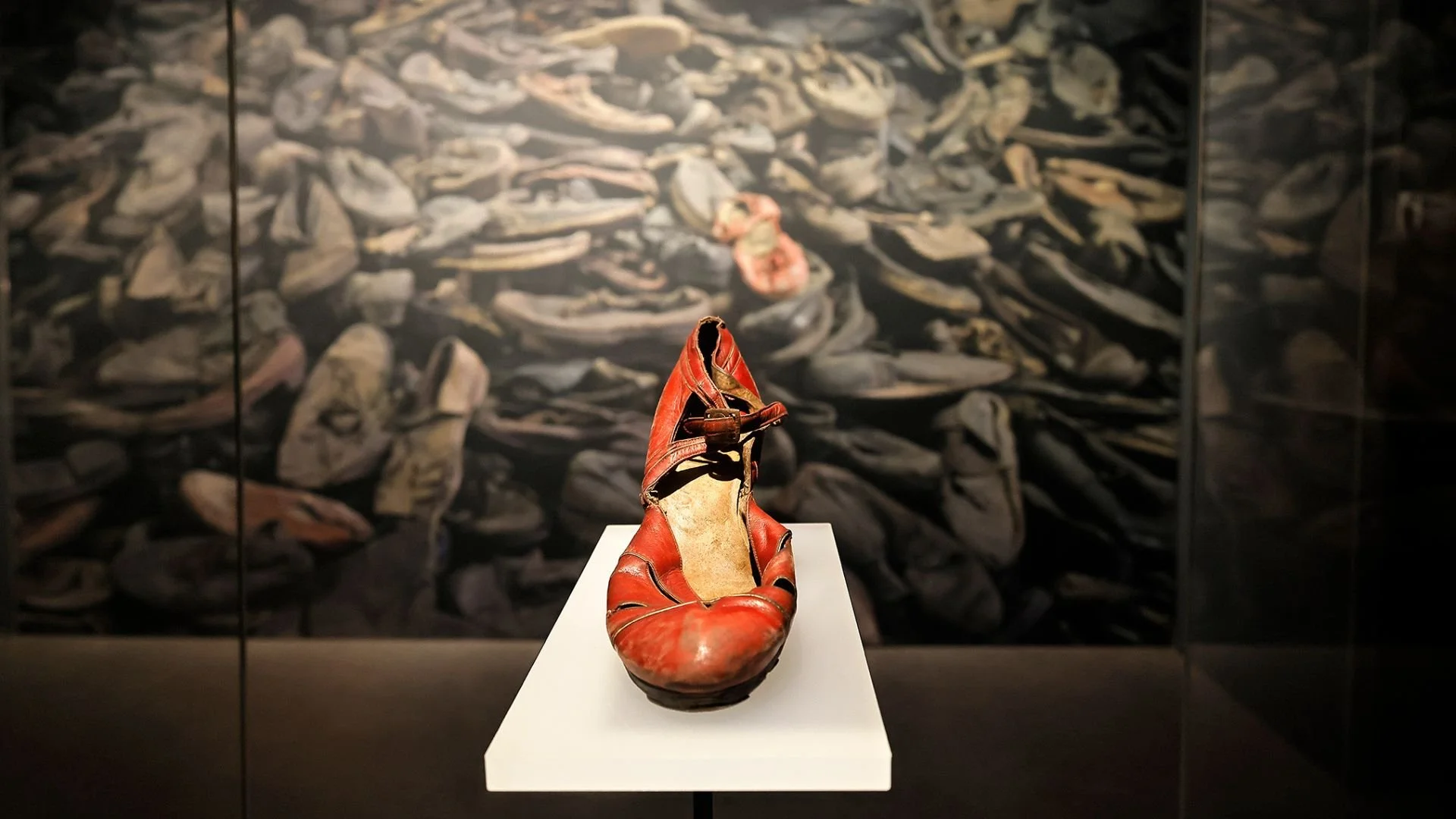
I heard about the shoes long before stepping foot into the Holocaust Exhibition yesterday in Cincinnati with the group of Cross of Gracers who made the trip there. Not only had I heard about the shoes, but I’d seen something similar at the Holocaust Museum in Washington, D.C. several years ago. In Cincinnati there were pictures and a couple of stories about individual shoes from murdered Jews. D.C.’s museum hosts an exhibit of actual shoes, though, piled several feet deep – hundreds of them – men’s shoes, women’s shoes, the tiny shoes of children – stacked, like bodies you might say, as a grisly reminder – not just of the number of lives destroyed by the Holocaust, but the very simple, profound, fairly universal symbol of humanity that was lost in those years.
What’s also sobering to realize is that there are museums and memorials around the world with equally large and disturbing piles of shoes of their own. Which makes sad, terrifying sense of course. More than six million murdered Jews leave behind plenty of shoes to go around. (And let us not forget the queer folk, the Roma people, those with disabilities, and thousands of others who were also murdered as part of Hitler’s Holocaust and Final Solution.)
Anyway, and of course, we also saw, yesterday, plenty of pictures, video footage, and so many living, personal testimonies about the horrors of that regime, and of those days, and of that sinful stain on humanity’s history. And they are difficult to see – sad, shameful, and scary – but necessary, to look at, in my opinion; as people of faith, as responsible citizens, as human beings on the planet, as children of God.
And, for so many reasons, I thought of these things when I thought about this morning’s Gospel.
See, when Jesus reminds Nicodemus about that time in Israel’s history when “Moses lifted up the serpent in the wilderness,” he’s recalling that strange story from the book of Numbers when God’s people had lost faith and had been disobedient and doubtful of God, so that poisonous serpents showed up to bite them as punishment, so the story goes. When they realized the error of their ways and asked for help, Moses – at God’s direction – put a bronze serpent on a pole, and set it up so that God’s people could look at the serpent – like some sort of sacred, spiritual anti-venom – and be healed from the poisonous of those snakes that had plagued them. They were called to look back; to face their fear; to stare their struggle, their sadness, their sin – the source of their pain and punishment – in the eye – in order to be healed of it.
And isn’t that, a lot of the time, the very last thing we are inclined to do – get close to and look at the source of our struggle and sinfulness, I mean? Isn’t it hard and scary, sometimes, to look our fear, our shame, our guilt, and our greatest threat in the eye? Aren’t we pretty good at – if not inherently wired for – avoiding so many of the difficult, scary, broken parts of our lives and of our history, rather than face them, admit them, let alone engage and get close to them and expect good things to come of it?
And it’s no wonder, really. Our world is an unforgiving, judgmental, punishment- seeking, vengeance-hungry, score-keeping, death-dealing kind of place to live in. Admitting mistakes is bad for approval ratings – just ask a politician. Failure is to be avoided at all costs – just ask a student or a young athlete in your life. Admitting sin and seeking forgiveness feels like weakness – just look in the mirror.
But this is what I hear Jesus ask of us in this morning’s Gospel. “Just as Moses lifted up the serpent in the wilderness, so must the Son of Man be lifted up” … on a pole… on a tree… on a cross for all the world to see, so that we might look at him, so that we might look to him for deliverance from that which we fear threatens us most – our greatest mistakes, our deepest guilt, our darkest shame, our unfathomable brokenness, our Sin – with a capital S – heaped upon God, in Jesus, and left to die on a cross.
And that’s the power – and the practical, holy importance – of museums and memorials that point to and remind us of our history, and that force us to look it straight in the eye, even when, especially when, it’s terrible and terrifying – like any Holocaust exhibit, like the Lynching Memorial in Montgomery, Alabama, like the Vietnam Wall, the 9/11 Museum, the Stonewall National Monument in Greenwich Village, New York.
These are hard, holy reminders of humanity’s capacity for inhumanity. But there is also warning and hope and potential for transformation when we dare to confront, study, learn from, and be changed by what we’ve done.
- I don’t know how anyone could spend 5 minutes in that Cincinnati exhibit and deny the atrocities of Hitler’s regime – but there are too many who still pretend it didn’t happen or that it wasn’t as bad as it was, and who refuse to believe what their eyes could see if they’d just look.
- After learning that some of the Nazi’s first sinister steps toward “Making Germany Great” included very deliberately “Germanizing” the names of towns, villages, and streets, I’ll think even harder every time I hear or see someone refer to “The Gulf of America” on a map.
- And when I hear about innocent US Citizens being unfairly, unjustly detained, imprisoned, and deported, I’ll remember the way that happened to innocent Japanese Americans once before, too, while we were simultaneously, ironically, fighting to liberate Jews from similar tyranny in the same damn war.
We need all the reminders and reality checks we can get, people. Because, as Maya Angelou used to say, something with which I believe Jesus would agree: “When you know better, you do better.”
That’s why yesterday – and all of this – is more than a history lesson for me. It’s an exercise of faith because these Lenten days are all about doing this work – looking back, acknowledging, admitting, confessing, repenting of our sins – working to change and be changed because of them – and extending mercy, grace and love to the world of God’s children as a result.
Because “God so loved the world that he gave his only Son, so that everyone who believes in him might have eternal life.” And because “God did not send the Son into the world to condemn the world, but in order that the world might be saved through him.”
It’s hard to look at what hurts, horrifies and threatens to kill us – at what has killed too many of us – and trust that, in doing so, we can be saved. But that’s Jesus’ invitation today, nonetheless… “to look and live” like those Israelites were commanded to do, way back when. To look at the Sin that has bitten us and that bites us, still. To see, repent for, and change all the ways we manage to break the heart of God; not avert our eyes, not run from, not pretend or deny the fullness of our Sin – and to not be fooled into believing God can’t redeem it, either.
And that’s why we look to the cross … so that we might stop hiding from the sins that hang there – all the things done, left undone, and yet to be done – so that we might look full in the face at our greatest shame and our deepest fears and into the threat of our own brokenness – into the face, even, of death – and to see God’s promised salvation in spite of it all.
Because when we see the whole of our SIN crucified and killed … then forgiven and raised to new life … it can’t bite, burden, or betray us any longer. And when we receive and accept the fullness of this grace, we can learn to walk in the shoes of our neighbor and live transformed lives in return – asking for forgiveness, extending mercy, and loving one another – wholly – the way we have already been loved, by God, in Jesus Christ, our Lord.
Amen
