
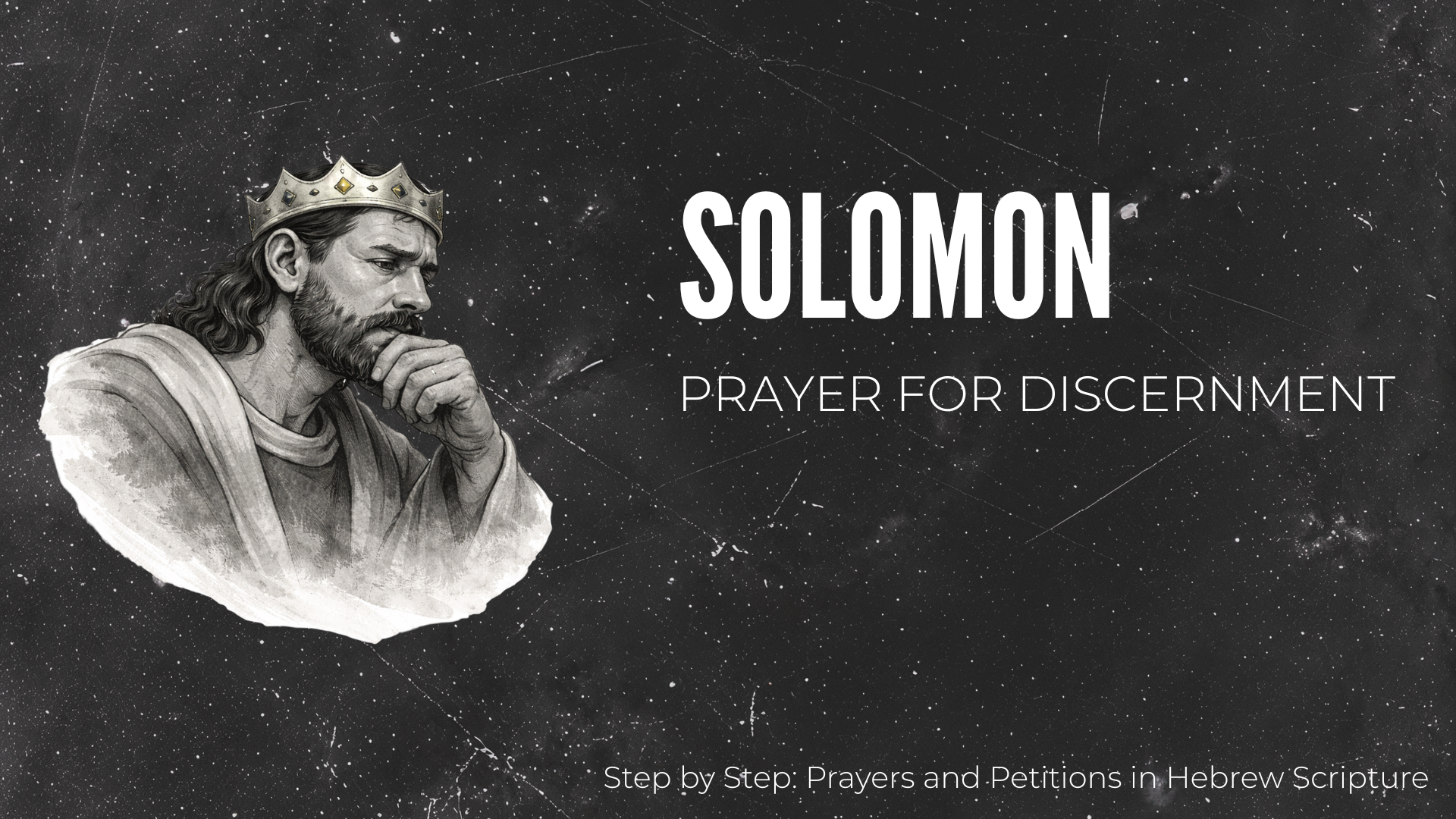
Solomon: Prayer for Discernment

1 Kings 3:4-14

The king went to Gibeon to sacrifice there, for that was the principal high place; Solomon used to offer a thousand burnt offerings on that altar. At Gibeon the Lord appeared to Solomon in a dream by night, and God said, “Ask what I should give you.” 

And Solomon said, “You have shown great and steadfast love to your servant my father David because he walked before you in faithfulness, in righteousness, and in uprightness of heart toward you, and you have kept for him this great and steadfast love and have given him a son to sit on his throne today. 

And now, O Lord my God, you have made your servant king in place of my father David, although I am only a little child; I do not know how to go out or come in. And your servant is in the midst of the people whom you have chosen, a great people so numerous they cannot be numbered or counted. 

Give your servant, therefore, an understanding mind to govern your people, able to discern between good and evil, for who can govern this great people of yours?”

It pleased the Lord that Solomon had asked this. God said to him, “Because you have asked this and have not asked for yourself long life or riches or for the life of your enemies but have asked for yourself understanding to discern what is right, I now do according to your word. Indeed, I give you a wise and discerning mind; no one like you has been before you, and no one like you shall arise after you. I give you also what you have not asked, both riches and honor all your life; no other king shall compare with you. 

If you will walk in my ways, keeping my statutes and my commandments, as your father David walked, then I will lengthen your life.”


Listen to your heart  when’s he’s calling for you. Listen to your heart, there’s nothing else you can do. I don’t know where you’re going and I don’t know why, but listen to your heart, before you tell him goodbye.
Yes, that’s Roxette’s 1988 power-ballad “Listen to Your Heart.” Be honest: how many of you wore out the cassette tape, belting it in the car? Songwriter Per Gessle says he wrote the tune after an all-night talk with his best friend whose marriage was crumbling. 

That pep-talk became a #1 hit, but here’s my problem with Per: catchy tune. Terrible advice; not only to his friend, but to the millions of people who listen to that song and think, “that’s how I’ll know what to do, I just need to listen to my heart.” 

The sentiment has become the go-to cliché for discernment. The motto sounds innocent enough, but its implications are anything but. “Listening to your heart” is really code for turning inward—figuring out what you want, what you think you need—and letting that be the deciding factor. 

We say it all the time in different ways: To the student choosing a major, study what makes you happy. 

To the friend considering a relationship, be with the one who makes you happy. To anyone eyeing a new city or job, go where you’ll be happy. With this Roxette wisdom, the most important person in the equation is you, and the measure of a good choice is whatever benefits you most. 

After all, as the song says, “there’s nothing else you can do.”

Except there is. Because sooner or later we realize that turning inward pulls us in a dozen directions. 

We don’t really know what we want; we misjudge what will make us happy—and we end up right back where we started, unsure what to do next. 

That’s the crossroads where Solomon stood, and his prayer flips the slogan on its head: discernment isn’t listening to your heart; it’s asking God for a listening heart, one attuned to God and to the people around you.

That request, a listening heart, is the heartbeat of this prayer. But notice how it starts. God says to the brand-new king, “Ask me for what I should give you.” Translation: Anything you want, Solomon - name it. Solomon responds with a little speech about how great God is and how faithful God was to his father David. 

It sounds a bit like a child buttering up a parent before the big ask: “Mom, you’re the best mom; can I have candy for breakfast?”

Solomon even calls himself “a little child who doesn’t know how to go out or come in.” Meaning, he has zero military experience; he doesn’t know how to lead an army out or bring one home—let alone guide a nation. That honesty is ironic, given how Solomon reached the throne.  

He wasn’t ushered in by popular acclaim like his father David; others were ahead of him. With some help, he muscled his way in, banishing rivals to far-off places, arranging a few convenient deaths. He rose less like an anointed king and more like a mafia boss. Now he admits he’s in over his head.

Solomon fought hard to reach the throne, only to realize he suddenly doesn’t know what to do. He could have made a candy-for-breakfast request—asking for the things kings usually crave: a long life, a larger kingdom, protection from rival nations. Had he turned inward and listened to his own heart, that’s likely what he would have asked for. But he doesn’t. Instead, he owns up to his limits and asks for help: “Give your servant an understanding mind to govern your people, able to discern between good and evil, for who can govern this great people of yours?” 

Understanding mind doesn’t quite get at the depth of the Hebrew. Solomon is literally asking for a listening heart. In the Old Testament world, the heart was the decision-making center where thought and passion met. Notice he isn’t asking for a good heart, but a listening one: attentive to the petitions of the people he now leads, tuned to God’s voice, able to choose between good and evil—between what brings life and what brings death.

This request almost seems surprising to God, who expected riches and long life and the death of enemies. But because Solomon did not ask for any of that, God gives the new king not only what he asked for, but also the very things he didn’t.

This is not a story telling us that if we butter God up just right and ask for the perfect thing, God will give it to us and then some. Rather, what I hope you see is that we have all been in something like Solomon’s position. Sure, you haven’t acted like the Godfather to get what you want—or at least I hope not. 

But all of us have found ourselves in a situation where others need us, depend on us, and we don’t know what to do. Maybe it’s something you’ve always wanted, something you’ve envisioned a thousand times, but once you finally arrived, you realized you had no idea what you were doing. Or perhaps you were thrust into a position you never wanted, and suddenly people are looking to you for help.

It’s the newly married couple with no idea what they’ve gotten themselves into. The new father who is overwhelmed with parenting. The person who just got a promotion—or a divorce, or a diagnosis, or a diploma—but has no idea what to do next.

What Solomon shows us is that rather than listen to your heart, we ask God for a listening heart: one that opens us to the needs of those around us, makes us aware of how our decisions affect others, and leads us to choose what brings life, not just for ourselves, but for all people. 

That’s true discernment. 

And that’s the prayer we carry with us tonight: God, give me a listening heart. In my home, in my work, in every place where others are depending on me. In those moments when I feel over my head and don’t know what to do, teach me to listen to you, and to those around me, so that what I choose leads to life.

Amen.


Love is Not Blind

John 9:1-41

As he walked along, he saw a man blind from birth. His disciples asked him, “Rabbi, who sinned, this man or his parents, that he was born blind?” Jesus answered, “Neither this man nor his parents sinned; he was born blind so that God’s works might be revealed in him. We must work the works of him who sent me while it is day; night is coming when no one can work. As long as I am in the world, I am the light of the world.” When he had said this, he spat on the ground and made mud with the saliva and spread the mud on the man’s eyes, saying to him, “Go, wash in the pool of Siloam” (which means Sent). Then he went and washed and came back able to see. The neighbors and those who had seen him before as a beggar began to ask, “Is this not the man who used to sit and beg?” Some were saying, “It is he.” Others were saying, “No, but it is someone like him.” He kept saying, “I am the man.” But they kept asking him, “Then how were your eyes opened?” He answered, “The man called Jesus made mud, spread it on my eyes, and said to me, ‘Go to Siloam and wash.’ Then I went and washed and received my sight.” They said to him, “Where is he?” He said, “I do not know.”

They brought to the Pharisees the man who had formerly been blind. Now it was a sabbath day when Jesus made the mud and opened his eyes. Then the Pharisees also began to ask him how he had received his sight. He said to them, “He put mud on my eyes. Then I washed, and now I see.” Some of the Pharisees said, “This man is not from God, for he does not observe the sabbath.” But others said, “How can a man who is a sinner perform such signs?” And they were divided. So they said again to the blind man, “What do you say about him? It was your eyes he opened.” He said, “He is a prophet.”

The Jews did not believe that he had been blind and had received his sight until they called the parents of the man who had received his sight and asked them, “Is this your son, who you say was born blind? How then does he now see?” His parents answered, “We know that this is our son, and that he was born blind; but we do not know how it is that now he sees, nor do we know who opened his eyes. Ask him; he is of age. He will speak for himself.” His parents said this because they were afraid of the Jews; for the Jews had already agreed that anyone who confessed Jesus to be the Messiah would be put out of the synagogue. Therefore his parents said, “He is of age; ask him.”

So for the second time they called the man who had been blind, and they said to him, “Give glory to God! We know that this man is a sinner.” He answered, “I do not know whether he is a sinner. One thing I do know, that though I was blind, now I see.” They said to him, “What did he do to you? How did he open your eyes?” He answered them, “I have told you already, and you would not listen. Why do you want to hear it again? Do you also want to become his disciples?” Then they reviled him, saying, “You are his disciple, but we are disciples of Moses. We know that God has spoken to Moses, but as for this man, we do not know where he comes from.” The man answered, “Here is an astonishing thing! You do not know where he comes from, and yet he opened my eyes. We know that God does not listen to sinners, but he does listen to one who worships him and obeys his will. Never since the world began has it been heard that anyone opened the eyes of a person born blind. If this man were not from God, he could do nothing.” They answered him, “You were born entirely in sins, and are you trying to teach us?” And they drove him out.

Jesus heard that they had driven him out, and when he found him, he said, “Do you believe in the Son of Man?” He answered, “And who is he, sir? Tell me, so that I may believe in him.” Jesus said to him, “You have seen him, and the one speaking with you is he.” He said, “Lord, I believe.” And he worshiped him. Jesus said, “I came into this world for judgment so that those who do not see may see, and those who do see may become blind.” Some of the Pharisees near him heard this and said to him, “Surely we are not blind, are we?” Jesus said to them, “If you were blind, you would not have sin. But now that you say, ‘We see,’ your sin remains.”


I’m not proud of it, but I binge-watched two-and-a-half seasons of the Netflix reality show “Love is Blind” over the course of two or three days, following my emergency gall bladder surgery in September. Again, I’m not proud. I confess. I repent. And I blame the pain meds.

The premise of this waste of time is that men and women go on literal blind dates, where they spend a period of time dating one another behind walls and closed doors, in private rooms. They sit in pods and have all manner of discussion about all manner of things and decide without ever seeing each other, that they are in love, or not. During all of this, the men live in one shared space and the women in another. So, there’s competition and gossip and lies and drama. Eventually, there are marriage proposals and then face-to-face meetings those who get engaged. Then the lucky, newly-engaged couples travel together for a group romantic getaway where there is lots of sunshine, beaches, swimsuits, hot tubs, and the like. And more competition, in-fighting, gossip, lies, and drama, of course.

All of this is build-up to each couple’s potential wedding day, the outcome of which is never known by anyone, for certain, until they reach the altar, dressed in tuxedos, wedding gowns and before very real pastors, priests, rabbis, and justices of the peace – according to their faith tradition, or lack thereof. Neither the viewer, nor the potential brides or the prospective grooms or their families, know for sure … until the very last moment … if the betrothed are going to say “I do.” Of course, the drama really comes when one of the two says “No” or “I Can’t” or “I Don’t” to their partner’s hopeful expression of love and commitment.

It’s terrible – once the meds wore off, the pain was gone, and I was on the mend, I didn’t even bother to finish that third season. It’s one of the many signs of the decline of western civilization, I’m sure. It’s one of many reasons, I suspect, that, if there is intelligent life on other planets, they’ve decidedly NOT bothered to make contact. All of this is mostly confession and repentance, but I’ll come back to it – however briefly – in a minute.

But first, this miracle story, which is a doozy … and a well-known one at that … the spit, the dirt, the mud pie – and this guy who’d been blind his whole life – who gets his eyesight back. And there are so many others … miracle stories, I mean, in Scripture: the little girl who gets up from a death-bed nap; Simon Peter’s mother-in-law, whose fever breaks; the demons who leave from that guy in the synagogue; the woman who had been hemorrhaging for years, the leper who’s made clean, and so on.

And you can’t help but wonder about all those people – in Jesus’ day and in our own – whose healing never comes: the demon that never leaves; the fever that never breaks; the blindness that never goes away, the cancer, the diabetes, the dying that seem to win the day.

And because of all that – because so many of us go without the miracles we long for – I can’t help but believe Jesus’ willingness and ability to heal doesn’t have as much to do with ridding people or the world of sickness as much as we’d like to believe or pretend. Just like the Pharisees, we get caught up in the “who, what, how, when, and where” of what Jesus did for this blind guy and we ignore or don’t care so much about what Jesus tells us – right at the beginning of it all – about the WHY of what he had done that day.

This guy had been born blind, remember. And to his parents, to his neighbors, to the Pharisees, certainly, and even to the blind guy himself, that meant he was sinful in some way. As we know, medical science back in the day wasn’t what it is for us now – so many generations later. When someone was sick or even just different somehow – whether it was leprosy, leukemia or whatever it is that makes a lame person unable to walk – their difference was understood to be proof that they were being judged by God and punished, then, for some kind of sin.

You can hear it in the disciples’ question to Jesus, before the healing occurs: “Rabbi, who sinned, this man or his parents that he was born blind?” (Apparently, on top of all the rest, your physical diseases and differences could also be the result of another person’s sins, as well as your own.) But Jesus doesn’t break out the medical books, give the man an eye exam, make a diagnosis, or chart a treatment plan. He says, “Neither this man nor his parents sinned; he was born blind so that God’s works might be revealed in him.” (Not only does this imply that there’s nothing wrong with being blind, but it lets us know God was up to something more than just a magic trick.)

So, Jesus gets to the business of doing “God’s works,” by way of a little mud and some spit. And if “miracle” means supernatural, irrational, unexpected, unexplainable – or something like that – here is where the real miracle of this morning’s Gospel occurs. The miracle of what God accomplishes through Jesus, not just for the blind man on the roadside that day so many years ago, but for every one of us – and our neighbors out there in the world, too – isn’t so much that God cures blindness; it’s that the eyes of those who can already see are opened to a God who loves without measure and promises eternal life, on this side of Heaven.

What the disciples, the Pharisees, the blind man and his family, friends and neighbors were meant to witness that day wasn’t just a physical healing. The real joy for this man who once was blind but now could see, wasn’t that he could throw away his walking stick or go get a driver’s license. The real miracle and true joy for the blind man who received his sight was that God transformed what had been called Sin, into forgiveness; God turned judgment into freedom; God made what was supposedly broken, whole; God made one who was unworthy, worthy – and loved and liberated and allowed to experience the fullness of the Kingdom, just like the rest of his friends, family, neighbors.

And that’s supposed to be our miracle, too.

The miracle of Jesus Christ is that God’s grace is big enough for all people – and especially for the sick, sinful, broken, needy, or just plain DIFFERENT by the standards of the world. That’s miraculously good news for the gay or trans kids too many pretend are sinful or broken for being born a certain way. This is good news for Jewish people in our day and age, being targeted and terrorized – still and yet again – by a world that can’t appreciate their status as God’s children. This is the Gospel for anyone who faces bigotry, discrimination, exclusion, or injustice because they don’t measure up, fit the mold, or walk, talk, live, move, or breathe like the masses – or to the liking of the powers that be.

What the world calls unworthy, God claims and cherishes. What the world can’t overlook, God forgives. What the world considers unlovable, God loves. What the world nails to a cross, God raises from the dead.

The most amazing miracle is that God’s love is most decidedly NOT blind. God sees all of us from the inside out – the broken and the beautiful; the sinful and the sacred; the holy and the horrible – and God loves us, still … and always … and commands us to do the same for one another, in the name of Jesus. And it’s no small miracle when we get it right.

Amen