
Discernment

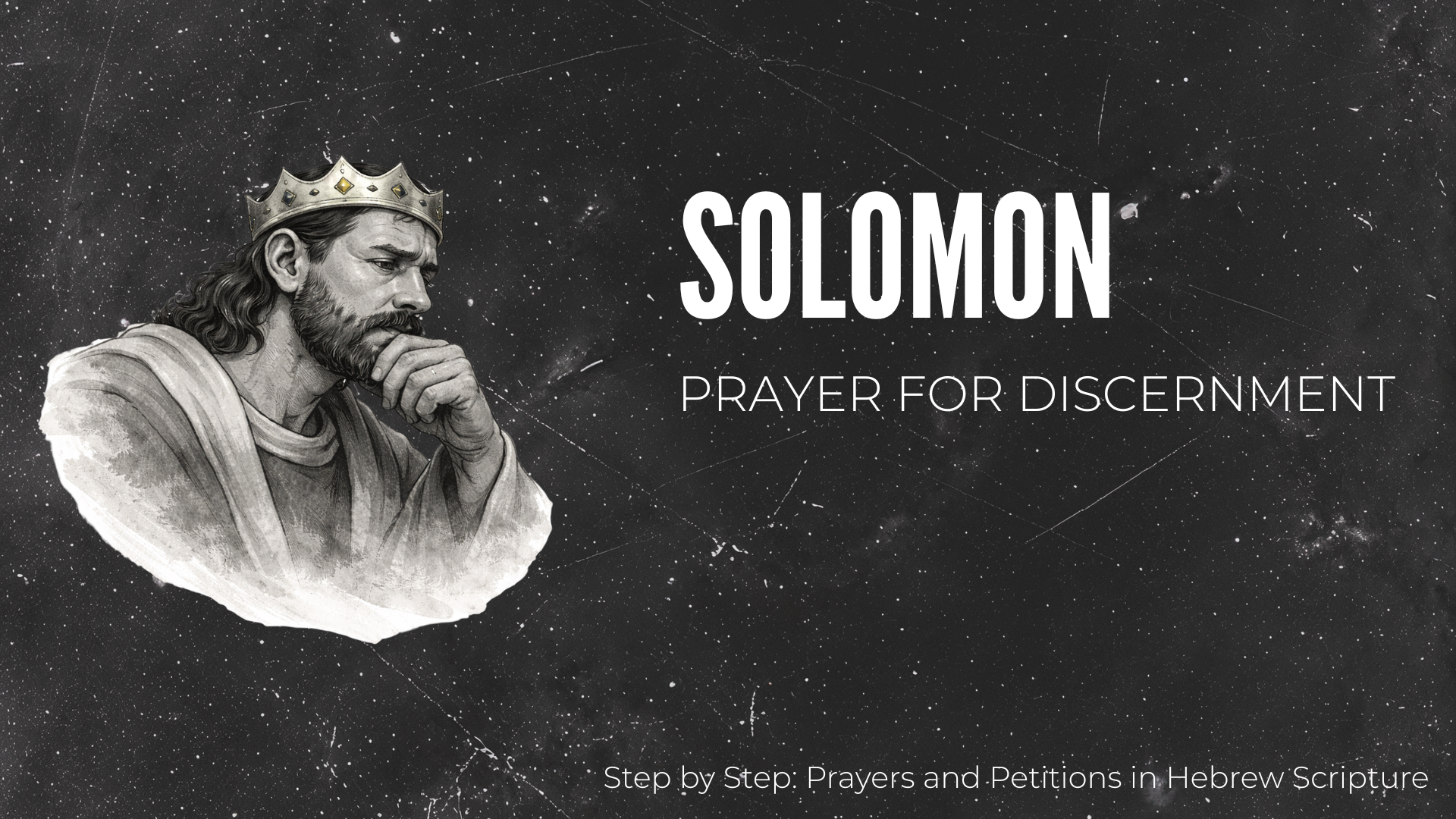
Solomon: Prayer for Discernment

1 Kings 3:4-14

The king went to Gibeon to sacrifice there, for that was the principal high place; Solomon used to offer a thousand burnt offerings on that altar. At Gibeon the Lord appeared to Solomon in a dream by night, and God said, “Ask what I should give you.” 

And Solomon said, “You have shown great and steadfast love to your servant my father David because he walked before you in faithfulness, in righteousness, and in uprightness of heart toward you, and you have kept for him this great and steadfast love and have given him a son to sit on his throne today. 

And now, O Lord my God, you have made your servant king in place of my father David, although I am only a little child; I do not know how to go out or come in. And your servant is in the midst of the people whom you have chosen, a great people so numerous they cannot be numbered or counted. 

Give your servant, therefore, an understanding mind to govern your people, able to discern between good and evil, for who can govern this great people of yours?”

It pleased the Lord that Solomon had asked this. God said to him, “Because you have asked this and have not asked for yourself long life or riches or for the life of your enemies but have asked for yourself understanding to discern what is right, I now do according to your word. Indeed, I give you a wise and discerning mind; no one like you has been before you, and no one like you shall arise after you. I give you also what you have not asked, both riches and honor all your life; no other king shall compare with you. 

If you will walk in my ways, keeping my statutes and my commandments, as your father David walked, then I will lengthen your life.”


Listen to your heart  when’s he’s calling for you. Listen to your heart, there’s nothing else you can do. I don’t know where you’re going and I don’t know why, but listen to your heart, before you tell him goodbye.
Yes, that’s Roxette’s 1988 power-ballad “Listen to Your Heart.” Be honest: how many of you wore out the cassette tape, belting it in the car? Songwriter Per Gessle says he wrote the tune after an all-night talk with his best friend whose marriage was crumbling. 

That pep-talk became a #1 hit, but here’s my problem with Per: catchy tune. Terrible advice; not only to his friend, but to the millions of people who listen to that song and think, “that’s how I’ll know what to do, I just need to listen to my heart.” 

The sentiment has become the go-to cliché for discernment. The motto sounds innocent enough, but its implications are anything but. “Listening to your heart” is really code for turning inward—figuring out what you want, what you think you need—and letting that be the deciding factor. 

We say it all the time in different ways: To the student choosing a major, study what makes you happy. 

To the friend considering a relationship, be with the one who makes you happy. To anyone eyeing a new city or job, go where you’ll be happy. With this Roxette wisdom, the most important person in the equation is you, and the measure of a good choice is whatever benefits you most. 

After all, as the song says, “there’s nothing else you can do.”

Except there is. Because sooner or later we realize that turning inward pulls us in a dozen directions. 

We don’t really know what we want; we misjudge what will make us happy—and we end up right back where we started, unsure what to do next. 

That’s the crossroads where Solomon stood, and his prayer flips the slogan on its head: discernment isn’t listening to your heart; it’s asking God for a listening heart, one attuned to God and to the people around you.

That request, a listening heart, is the heartbeat of this prayer. But notice how it starts. God says to the brand-new king, “Ask me for what I should give you.” Translation: Anything you want, Solomon - name it. Solomon responds with a little speech about how great God is and how faithful God was to his father David. 

It sounds a bit like a child buttering up a parent before the big ask: “Mom, you’re the best mom; can I have candy for breakfast?”

Solomon even calls himself “a little child who doesn’t know how to go out or come in.” Meaning, he has zero military experience; he doesn’t know how to lead an army out or bring one home—let alone guide a nation. That honesty is ironic, given how Solomon reached the throne.  

He wasn’t ushered in by popular acclaim like his father David; others were ahead of him. With some help, he muscled his way in, banishing rivals to far-off places, arranging a few convenient deaths. He rose less like an anointed king and more like a mafia boss. Now he admits he’s in over his head.

Solomon fought hard to reach the throne, only to realize he suddenly doesn’t know what to do. He could have made a candy-for-breakfast request—asking for the things kings usually crave: a long life, a larger kingdom, protection from rival nations. Had he turned inward and listened to his own heart, that’s likely what he would have asked for. But he doesn’t. Instead, he owns up to his limits and asks for help: “Give your servant an understanding mind to govern your people, able to discern between good and evil, for who can govern this great people of yours?” 

Understanding mind doesn’t quite get at the depth of the Hebrew. Solomon is literally asking for a listening heart. In the Old Testament world, the heart was the decision-making center where thought and passion met. Notice he isn’t asking for a good heart, but a listening one: attentive to the petitions of the people he now leads, tuned to God’s voice, able to choose between good and evil—between what brings life and what brings death.

This request almost seems surprising to God, who expected riches and long life and the death of enemies. But because Solomon did not ask for any of that, God gives the new king not only what he asked for, but also the very things he didn’t.

This is not a story telling us that if we butter God up just right and ask for the perfect thing, God will give it to us and then some. Rather, what I hope you see is that we have all been in something like Solomon’s position. Sure, you haven’t acted like the Godfather to get what you want—or at least I hope not. 

But all of us have found ourselves in a situation where others need us, depend on us, and we don’t know what to do. Maybe it’s something you’ve always wanted, something you’ve envisioned a thousand times, but once you finally arrived, you realized you had no idea what you were doing. Or perhaps you were thrust into a position you never wanted, and suddenly people are looking to you for help.

It’s the newly married couple with no idea what they’ve gotten themselves into. The new father who is overwhelmed with parenting. The person who just got a promotion—or a divorce, or a diagnosis, or a diploma—but has no idea what to do next.

What Solomon shows us is that rather than listen to your heart, we ask God for a listening heart: one that opens us to the needs of those around us, makes us aware of how our decisions affect others, and leads us to choose what brings life, not just for ourselves, but for all people. 

That’s true discernment. 

And that’s the prayer we carry with us tonight: God, give me a listening heart. In my home, in my work, in every place where others are depending on me. In those moments when I feel over my head and don’t know what to do, teach me to listen to you, and to those around me, so that what I choose leads to life.

Amen.


How to be Human

Mark 1:29-39

As soon as they left the synagogue, they entered the house of Simon and Andrew, with James and John. Now Simon’s mother-in-law was in bed with a fever, and they told him about her at once. He came and took her by the hand and lifted her up. Then the fever left her, and she began to serve them.

That evening, at sunset, they brought to him all who were sick or possessed with demons. And the whole city was gathered around the door. And he cured many who were sick with various diseases, and cast out many demons; and he would not permit the demons to speak, because they knew him.

In the morning, while it was still very dark, he got up and went out to a deserted place, and there he prayed. And Simon and his companions hunted for him. When they found him, they said to him, ‘Everyone is searching for you.’ He answered, ‘Let us go on to the neighboring towns, so that I may proclaim the message there also; for that is what I came out to do.’ And he went throughout Galilee, proclaiming the message in their synagogues and casting out demons.


The Super Bowl is next week and my household is rather excited. Some of us for the game and others of us for the commercials, Usher at Half Time, and most importantly the Taylor Swift appearances. I have always been a football fan, I played growing up and in high school and have always loved watching Colts games with my family. Recently, I listened to a podcast from the Athletic on Andrew Luck. I am guessing most of you are familiar with him, but for those not, Luck was the Colts first round draft pick in 2012.

We had a dismal season in 2011, we lost Peyton Manning, but there was all this hype around a young, nerdy, very athletic quarterback out of Stanford. Despite the enormous pressure Luck faced, he delivered. Immediately, he made an impact: throwing touchdowns, taking hits and getting right back up, even taking the Colts to multiple playoff appearances. At times, Luck seemed more God-like than human on the football field. Everything was pointing to the Colts making a superbowl run, that is until August 24, 2019.

To the shock and disappointment of many, the 29 year old, with potentially some of his best years ahead of him, decided to retire, to move on from football. Over the last four years of playing, Luck went through a vicious cycle of injury, pain, rehab. He was amazing to watch, but it came at the cost of his body: Torn cartilage in 2 ribs, partially torn abdomen, a lacerated kidney, at least 1 concussion, a torn labrum in his throwing shoulder, and a calf/ankle issue that he’d been dealing with. At the press conference announcing his retirement, Luck said “I feel quite exhausted and quite tired. It’s been tiring. I feel tired, and not just in the physical sense.”

But in the very next breath, Luck said "I feel so much clarity [about this] and so grateful for the experiences..." At that press conference, Luck showed us that he wasn’t just a football player, or some superhuman athlete. He was human.

And even though he was beloved by fans, coaches, and this city, Luck discerned that if he continued playing football it would come at the cost of his body, his family, and the life he wanted. So he moved in a different direction. It was a remarkable decision. So what do Andrew Luck and Jesus have in common? They show us what it means to be human: That is, they’re exhausted, they discern what to do next, and with great clarity they move in a different direction.

The last five weeks we have explored stories that show us who Jesus is and what he is all about. Think of the stories we’ve explored: the magi calling Jesus as King of the Jews, Nathaniel saying he is the Son of God, fishermen dropping everything to follow him, and he can even cast out unclean spirits. But this week we are shown something different.

This week our story picks up on the same day Jesus cast out that unclean spirit. He and the disciples are just leaving the synagogue as word spreads about the miracle. They go to Simon and Andrew’s house. Right away, Jesus heals Simon’s mother-in-law of a fever. Amazed, the disciples then bring to him everyone they know who is sick or demon possessed for healing. The whole city has gathered outside this little house to see the spectacle! In just one day, Jesus had taught in the synagogue, performed his first exorcism and healing, and then healed and cast out many that same night.

Jesus had to be exhausted. So that next morning, before the sun is up, Jesus awakes, retreats to a deserted place alone, and prays. And right there we are shown something different about Jesus than in all the other epiphany stories. We are shown that Jesus is human. He hit a limit. He was tired. He needed time alone; to recharge. He needed to pray, to listen to God, to discern what came next, before he was bombarded with the demands of the people around him.

And that time didn’t last long. The disciples hunted for him, frantically searching. And when they found him, they informed Jesus that everyone was looking for him. As if to say, “what in the world are you doing out here? People are looking for you, you’ve got to heal them”. Yet, likely to their shock and disappointment, Jesus said “Let’s move on to other towns; there’s more preaching and healing needed. After all, that’s what I came to do.”

Jesus had clarity about what the next move was in his ministry. He knew he wouldn’t be able to do what he was called to do if he just stayed there.

This life demands a great deal from us. People and powers try to pull us in all sorts of directions, telling us who we should be and what we should do. They want all that you can give and then ask for more. We will get tired, overwhelmed, exhausted even. It’s only human. And it’s so easy to just continue on doing what’s asked of you, even at the cost of yourself and the kind of life God really desires for you. Which is why, just like Jesus, we too need time to recharge, to pray, to listen to God, to discern what comes next, before the bombardment of demands continues. In that time and space, God gives clarity about what we are called to and gives our weary selves power to do it. It might be in a different direction than you thought, it might come as a shock or disappointment to others.

But, by faith, we trust we will be headed where God is leading and giving us strength along the way. Everyone will faint and grow weary as Isaiah says; but those who wait for the Lord, those who go off to pray, to listen, to discern, will have renewed strength.

And just as we need time of discernment and prayer in our individual lives, we need it in our life together, too. We as a community will feel the pull to do so many different ministries, serve in so many ways. The world around us will say we need to be more like this church or that organization or do more programs. It can be overwhelming, exhausting even.

But Jesus shows us another way. A way we are trying to follow with our Holy Conversations that begin today.

It's vital to our mission and ministry that we pray together. That we listen to each other, to our leadership, and most importantly to where we hear God at work in all of this. Where, to what, and to whom is God leading us? Who needs to come alongside us? What is the need that calls us to serve in new ways and in new places?

There is energy and excitement in this place. So now is the time to create the space and time for us to discern together; to dream about what comes next.

Yet in all of this what doesn’t change is who we are and what our ministry is. Jesus went on to the neighboring towns, but he still preached the gospel and healed people; that part never changed. No matter what comes next for us, we remain a community of disciples offering grace, no strings attached. We will continue to worship, learn about, and serve the everlasting God who does not faint or grow weary, but gives power to the tired and strengthens the weak.

And so we pray that God will guide these Holy Conversations, giving us clarity to God’s call, and empowering us to do the ministry that is before us.

Amen.