1 Kings 3:4-14
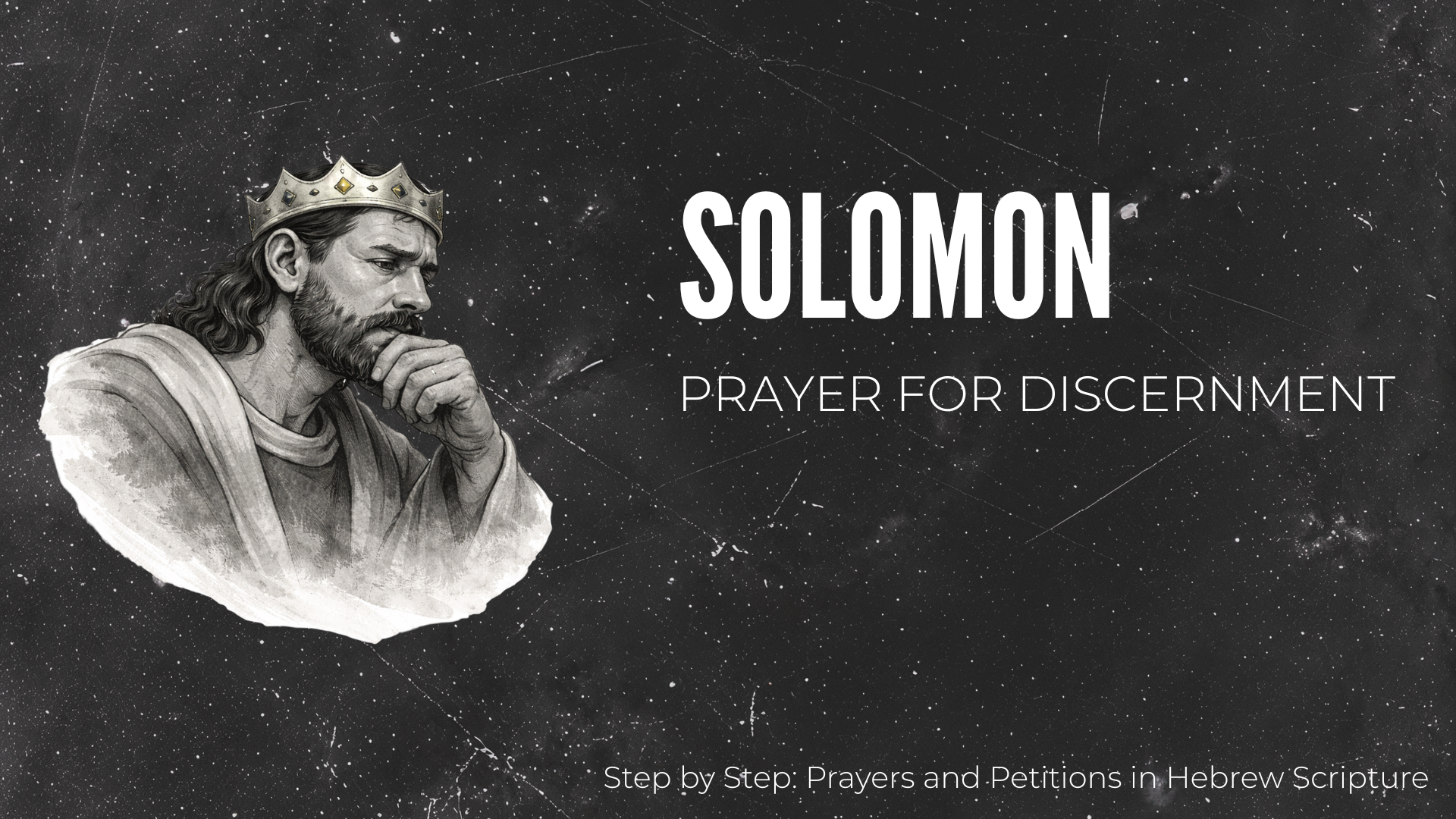
The king went to Gibeon to sacrifice there, for that was the principal high place; Solomon used to offer a thousand burnt offerings on that altar. At Gibeon the Lord appeared to Solomon in a dream by night, and God said, “Ask what I should give you.”
And Solomon said, “You have shown great and steadfast love to your servant my father David because he walked before you in faithfulness, in righteousness, and in uprightness of heart toward you, and you have kept for him this great and steadfast love and have given him a son to sit on his throne today.
And now, O Lord my God, you have made your servant king in place of my father David, although I am only a little child; I do not know how to go out or come in. And your servant is in the midst of the people whom you have chosen, a great people so numerous they cannot be numbered or counted.
Give your servant, therefore, an understanding mind to govern your people, able to discern between good and evil, for who can govern this great people of yours?”
It pleased the Lord that Solomon had asked this. God said to him, “Because you have asked this and have not asked for yourself long life or riches or for the life of your enemies but have asked for yourself understanding to discern what is right, I now do according to your word. Indeed, I give you a wise and discerning mind; no one like you has been before you, and no one like you shall arise after you. I give you also what you have not asked, both riches and honor all your life; no other king shall compare with you.
If you will walk in my ways, keeping my statutes and my commandments, as your father David walked, then I will lengthen your life.”
Listen to your heart when’s he’s calling for you. Listen to your heart, there’s nothing else you can do. I don’t know where you’re going and I don’t know why, but listen to your heart, before you tell him goodbye.
Yes, that’s Roxette’s 1988 power-ballad “Listen to Your Heart.” Be honest: how many of you wore out the cassette tape, belting it in the car? Songwriter Per Gessle says he wrote the tune after an all-night talk with his best friend whose marriage was crumbling.
That pep-talk became a #1 hit, but here’s my problem with Per: catchy tune. Terrible advice; not only to his friend, but to the millions of people who listen to that song and think, “that’s how I’ll know what to do, I just need to listen to my heart.”
The sentiment has become the go-to cliché for discernment. The motto sounds innocent enough, but its implications are anything but. “Listening to your heart” is really code for turning inward—figuring out what you want, what you think you need—and letting that be the deciding factor.
We say it all the time in different ways: To the student choosing a major, study what makes you happy.
To the friend considering a relationship, be with the one who makes you happy. To anyone eyeing a new city or job, go where you’ll be happy. With this Roxette wisdom, the most important person in the equation is you, and the measure of a good choice is whatever benefits you most.
After all, as the song says, “there’s nothing else you can do.”
Except there is. Because sooner or later we realize that turning inward pulls us in a dozen directions.
We don’t really know what we want; we misjudge what will make us happy—and we end up right back where we started, unsure what to do next.
That’s the crossroads where Solomon stood, and his prayer flips the slogan on its head: discernment isn’t listening to your heart; it’s asking God for a listening heart, one attuned to God and to the people around you.
That request, a listening heart, is the heartbeat of this prayer. But notice how it starts. God says to the brand-new king, “Ask me for what I should give you.” Translation: Anything you want, Solomon - name it. Solomon responds with a little speech about how great God is and how faithful God was to his father David.
It sounds a bit like a child buttering up a parent before the big ask: “Mom, you’re the best mom; can I have candy for breakfast?”
Solomon even calls himself “a little child who doesn’t know how to go out or come in.” Meaning, he has zero military experience; he doesn’t know how to lead an army out or bring one home—let alone guide a nation. That honesty is ironic, given how Solomon reached the throne.
He wasn’t ushered in by popular acclaim like his father David; others were ahead of him. With some help, he muscled his way in, banishing rivals to far-off places, arranging a few convenient deaths. He rose less like an anointed king and more like a mafia boss. Now he admits he’s in over his head.
Solomon fought hard to reach the throne, only to realize he suddenly doesn’t know what to do. He could have made a candy-for-breakfast request—asking for the things kings usually crave: a long life, a larger kingdom, protection from rival nations. Had he turned inward and listened to his own heart, that’s likely what he would have asked for. But he doesn’t. Instead, he owns up to his limits and asks for help: “Give your servant an understanding mind to govern your people, able to discern between good and evil, for who can govern this great people of yours?”
Understanding mind doesn’t quite get at the depth of the Hebrew. Solomon is literally asking for a listening heart. In the Old Testament world, the heart was the decision-making center where thought and passion met. Notice he isn’t asking for a good heart, but a listening one: attentive to the petitions of the people he now leads, tuned to God’s voice, able to choose between good and evil—between what brings life and what brings death.
This request almost seems surprising to God, who expected riches and long life and the death of enemies. But because Solomon did not ask for any of that, God gives the new king not only what he asked for, but also the very things he didn’t.
This is not a story telling us that if we butter God up just right and ask for the perfect thing, God will give it to us and then some. Rather, what I hope you see is that we have all been in something like Solomon’s position. Sure, you haven’t acted like the Godfather to get what you want—or at least I hope not.
But all of us have found ourselves in a situation where others need us, depend on us, and we don’t know what to do. Maybe it’s something you’ve always wanted, something you’ve envisioned a thousand times, but once you finally arrived, you realized you had no idea what you were doing. Or perhaps you were thrust into a position you never wanted, and suddenly people are looking to you for help.
It’s the newly married couple with no idea what they’ve gotten themselves into. The new father who is overwhelmed with parenting. The person who just got a promotion—or a divorce, or a diagnosis, or a diploma—but has no idea what to do next.
What Solomon shows us is that rather than listen to your heart, we ask God for a listening heart: one that opens us to the needs of those around us, makes us aware of how our decisions affect others, and leads us to choose what brings life, not just for ourselves, but for all people.
That’s true discernment.
And that’s the prayer we carry with us tonight: God, give me a listening heart. In my home, in my work, in every place where others are depending on me. In those moments when I feel over my head and don’t know what to do, teach me to listen to you, and to those around me, so that what I choose leads to life.
Amen.
