
Theology of Glory

Ecce Doxa

Ecce Doxa
Pastor Cogan

John 17:1-11

After Jesus had spoken these words, he looked up to heaven and said,

“Father, the hour has come; glorify your Son so that the Son may glorify you, since you have given him authority over all people, to give eternal life to all whom you have given him. And this is eternal life, that they may know you, the only true God, and Jesus Christ, whom you have sent. I glorified you on earth by finishing the work that you gave me to do. So now, Father, glorify me in your own presence with the glory that I had in your presence before the world existed.

“I have made your name known to those whom you gave me from the world. They were yours, and you gave them to me, and they have kept your word. Now they know that everything you have given me is from you, for the words that you gave to me I have given to them, and they have received them and know in truth that I came from you, and they have believed that you sent me. I am asking on their behalf; I am not asking on behalf of the world but on behalf of those whom you gave me, because they are yours. All mine are yours, and yours are mine, and I have been glorified in them.

And now I am no longer in the world, but they are in the world, and I am coming to you. Holy Father, protect them in your name that you have given me, so that they may be one, as we are one.


Katelyn and I saw The Devil Wears Prada 2 this weekend. I hadn’t seen the first one, you don’t really need to. In the film, I couldn’t help but notice how glory was on full display: fame, beauty, influence, excellence. Even when the movie tries to offer an alternative, Andy, the main character, can’t leave the lure of it all. Either we come from glory and do everything we can to hold onto it, or we are bound for glory and will do everything we can to get there.

That’s a story we tell about ourselves too: as individuals, communities, businesses, churches. Glory defined as success, relative wealth, stability, and growth. We might get off track for a moment, but with enough effort we believe we can get right back on the glory road. Most of us believe or once believed, that we are destined for great things. More blessings are just around the corner. And if not, then we have been slighted, short changed, or somehow cheated.

Glory gets a bad rap in Lutheran circles, and for good reason. Yet we can’t escape it. In just five verses from John, Jesus speaks of glory five times. The first thing he asks of God is, “Glorify your Son so that the Son may glorify you.” Peter says the Spirit of glory rests upon us. Throughout the New Testament, glory appears everywhere in crowns, white robes, and thrones.

Perhaps glory isn’t the problem after all. Perhaps we are simply confused about what glory actually is.

The story of an artist and her art can help us see this differently.

Cecilia Gimenez lived a struggling life. She was a widow in the small town of Borja, Spain. Her two sons, Jesús and Jose, were both born crippled. Jesús had muscular dystrophy and died at 20. Jose had cerebral palsy and needed his mother’s full-time care. Cecilia worked at a bar to bring in extra money.

To comfort herself, she volunteered at her church, the beautiful Sanctuary of the Pitiful Heart. She loved that church dearly. She was married there. Her boys received first communion there. But the centuries-old church didn’t have much money, so parishioners helped however they could.

Cecilia was a painter, and she painted where and when she could.

One day in August of 2012, the 81-year-old painter noticed the sorry state of the church’s fresco, Ecce Homo. Over time, salt and moisture from the aquifer beneath the church had deteriorated the painting until it looked like this. Without express permission, Cecilia decided to restore it herself. She had touched up the painting before, and the priest knew about that, but nothing quite like this.

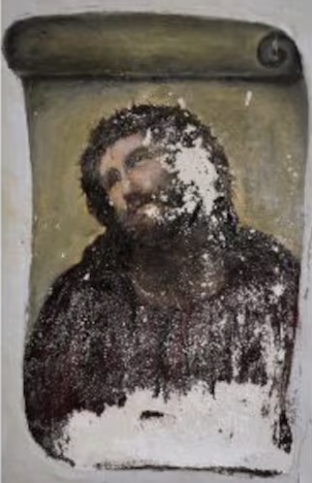
Mostly a painter of flowers, she had little experience with portraits. So she began with the tunic. Easy enough. Then came Jesus’ face, which proved far more difficult. She stopped, took a two-week holiday, and intended to return later to finish the work. But there was one slight problem: while she was away, the local art center discovered the restoration attempt. They informed the artist’s family. Together they raised a ruckus, and soon Cecilia’s unfinished work was all over the internet. And the internet did what only the internet can do: drag a stranger through the virtual mud without knowing the full story.

Memes were everywhere. The painting was dubbed Ecce Mono, or Monkey Christ. Art critics and strangers alike said awful things about her. Soon the media chased her through the streets. Utterly humiliated, she cried at home and refused to eat, losing 13 pounds in just days. Finally, overcome with despair, she was refined to her bed.

Such suffering when all she wanted was to serve God the best way she knew how. And she was ridiculed for it.

Maybe you know something about that. Maybe you’ve tried to help someone you love only to have your motives questioned. Maybe you poured yourself into your children and still wonder if you got it all wrong.

Maybe you volunteered, gave your time and talents, only to feel unnoticed or criticized. Maybe you tried to do the faithful thing, the loving thing, and instead of gratitude or joy, it brought exhaustion, conflict, embarrassment, or pain.

We expect our striving to be met with acceptance, maybe even glory. Yet so often it leaves us wounded instead. Oddly enough, according to Jesus, glory does not look like influence, success, or self-assertion. It looks like the cross. Jesus says, “I glorified you on earth by finishing the work that you gave me to do.” And that work was a life poured out in love for others. A cruciform glory, as one pastor calls is. Glory revealed not in grasping for power, but in service. Not in demanding our own way, but in sacrifice for another. Not in avoiding vulnerability, but entering into it out of love.

That kind of life often involves suffering, because it’s so opposite of the ways of this world. But suffering itself is not the glory. Love is. The glory is Christ revealed through mercy, service, sacrifice, and steadfastness. And somehow God brings resurrection out of places the world expects only humiliation or defeat.

Just ask Cecilia.

Shortly after being bedridden, flowers and a card arrived with some kind words. More followed. Then the visitors came to Borja, not to torture her, but to see the painting for themselves. Over 50,000 people came. Still today 15 to 20 thousand come annually. The church started charging three euros to enter. They set up a shop and sold Ecce Homo t-shirts, mugs, pencils, magnets, even wine. The money funded not only the church, but the nearby hospital for elderly folks who couldn’t afford care. Cecilia received money too, but when she felt she didn’t need any more she gave it to muscular-dystrophy charities in honor of her son Jesús.

Perhaps most miraculous, the perception that Cecilia wasn’t an artist changed. The family of the original artist decided not to restore the fresco, but keep Cecilia’s work. People and art critics began to take that work seriously, finding its simplicity moving, the work of a devoted believer who loved her church and simply wanted to offer something beautiful.

And maybe that was the glory all along. Not the mockery she endured online or in person. Not the fame that followed. But the quiet, cruciform beauty of someone who served without seeking recognition.

A widow caring for her disabled sons. An elderly woman painting church walls because she loved her congregation. A believer trying, however imperfectly, to honor Christ.

And somehow, out of that humble, some say botched, offering, God brought unexpected new life: care for the elderly, support for muscular dystrophy charities, renewed community, and a different kind of beauty for people to behold.

Cecilia died this past Christmas at 94. As C.S. Lewis once wrote, the promise of glory is the promise that because of Christ, we will please God.I am certain God said to her, “Well done, good and faithful servant.”

Glory is not found in wealth, fame, success, or a 1.5 trillion dollar military budget. Nor is it found merely in art and beauty themselves. Rather, glory is revealed in love poured out for another. Or, at least, that’s what I keep telling myself as Katelyn and I prepare to welcome baby number two any day now.

I know the sleepless nights, the poopy diapers, and the immense overstimulation headed my way will not look, feel, smell, or sound glorious. But somehow, even there, Christ and his glory are revealed through it all. Because it is love poured out for another.

And I believe the same is true for you and whatever your struggle, whatever your sacrifice, whatever service you are enduring and offering in your own life. Glory is not the opposite of any of that. Rather, in Christ and by his cross, God keeps bringing new life, mercy, and even glory out of what the rest of the world only sees as failure, exhaustion, or defeat.

In that way, we are all bound for glory. Thanks be to God.

Amen.

"Crosses & Crowns" – Mark 10:17-31

Crosses and Crowns
Mark Havel

Mark 10:17-31

As [Jesus] was setting out on a journey, a man ran up and knelt before him, and asked him, “Good Teacher, what must I do to inherit eternal life?”Jesus said to him, “Why do you call me good? No one is good but God alone. You know the commandments: ‘You shall not murder; You shall not commit adultery; You shall not steal; You shall not bear false witness; You shall not defraud; Honor your father and mother.’ ” He said to him, “Teacher, I have kept all these since my youth.” Jesus, looking at him, loved him and said, “You lack one thing; go, sell what you own, and give the money to the poor, and you will have treasure in heaven; then come, follow me.” When he heard this, he was shocked and went away grieving, for he had many possessions.

Then Jesus looked around and said to his disciples, “How hard it will be for those who have wealth to enter the kingdom of God!” And the disciples were perplexed at these words. But Jesus said to them again, “Children, how hard it is to enter the kingdom of God! It is easier for a camel to go through the eye of a needle than for someone who is rich to enter the kingdom of God.” They were greatly astounded and said to one another, “Then who can be saved?” Jesus looked at them and said, “For mortals it is impossible, but not for God; for God all things are possible.”

Peter began to say to him, “Look, we have left everything and followed you.” Jesus said, “Truly I tell you, there is no one who has left house or brothers or sisters or mother or father or children or fields, for my sake and for the sake of the good news, who will not receive a hundredfold now in this age—houses, brothers and sisters, mothers and children, and fields, with persecutions—and in the age to come eternal life. But many who are first will be last, and the last will be first.”


Crosses and Crowns: Theology of the Cross vs. Theology of Glory

For those of you who don’t know, Reformation Sunday is on the way and it’s one of the high holy days of the church calendar for Lutheran-flavored Christians, because it marks the birthday, if you will, of the Protestant Reformation, or the becoming of the Lutheran church and so many other denominations of Christianity as we understand it today. And, it’s been a couple of years since we’ve made our way to Reformation Sunday by way of a sermon series. So I thought it would be fun, again, to consider, over the course of the next few weeks, some of the things that make Lutherans Lutherans.

So… “The Theology of the Cross vs. The Theology of Glory” … one of the more profound and meaningful starting points for understanding who and how God is in the world. Like so many other theological perspectives, what we’re talking about today isn’t unique to Lutherans in our day and age, but it is an understanding rooted in Reformation theology, with thanks to our namesake, Martin Luther, in many ways.

And I realized this week that I could preach this sermon with pictures in no time, flat; that I could describe the difference between the Theology of the Cross and the Theology of Glory, by simply showing you these two images:

Theology of the Cross

Theology of the Cross

Theology of Glory

Theology of Glory

Now, as tempting as it is to say “Amen” and call it a day, there is also more to say about this.

One of the ways we talk about God’s love, in Jesus, is that it always comes down.  That’s what Lutheran theologians and seminary professors and pastors call a “Theology of the Cross,” which is meant to stand in contrast to something else we call a “Theology of Glory.”  I like to think of God’s example for us in Jesus Christ as one who got down and dirty for the sake of grace in the world – a Theology of the Cross – as opposed to being all high and mighty – a Theology of Glory.

So I want to start with some of what this Theology of Glory smells like. (It really does kind of stink once you develop a nose for it.) If you want to find other examples of this, start a log of “Christian-themed” bumper stickers when you see them, or thumb through the “religious” themed get-well cards at the drug store, or, depending on your Facebook “friends list”, consider the platitudes and pleasantries posted there, or just go shopping for what’s hot at the local Christian book store. (“Happy, Happy, Happy: My Life and Legacy as Duck Commander,” for instance. I haven’t read the book, so I’m totally guessing, which may not be fair, but you get the point, right?)

Anything like, “God never closes a door without opening a window,” or “God never gives you more than you can handle” are some common examples of this Theology of Glory. Or there’s this: Jesus as Hulk Hogan, or Superman, or Duane “the Rock” Johnson, rather than the “Rock of Ages Cleft for Me.”

To the contrary, though, we have our Theology of the Cross – which means to remind us of the truth that sometimes the door closes and the window’s stuck, too. Sometimes, while God doesn't make the bad stuff come, life really does give us more than we can handle, plain and simple. And, in reality, the cross was not some sort of comic book kryptonite that sapped the power from Jesus for a spell – it killed him, utterly, completely, dead…signed, sealed and delivered into the hands of death and despair and oblivion.

The cross of Christ is a reminder and a message that God’s love for us and God’s call to us is about humility and suffering and struggle.  God showed up to us in a stinky, smelly, underrated manger and God’s grace was unveiled to the world through an ugly, painful, lonely, desperate crucifixion and death.

And it is still that way. God shows up for us in places and in people and in opportunities where we least expect it – not in the high and mighty, but in the down and out; not in the rich and powerful, but in the poor and pitiful; not in the accepted and the exceptional, but in the neglected and the unacceptable, the left out, the lonely, the lost and the loser.

And God shows up through us, too – and here’s the invitation and the holy challenge of it all – when we embrace and engage and embody what is least among us. And, I would say, when we embrace and engage and embody the least and most lacking parts of ourselves … that’s how we experience resurrection and new life and the Kingdom of God in our midst.

Think, if you can, about some of the hardest, most vulnerable, sad and scary times of your life…(going through the basement or the attic or the garage after the funeral); think of some of your deepest, darkest struggles…(not making the team, not passing the test, sitting by that hospital bed waiting for the breathing to slow and to stop, walking out the door for the very last time); think about some of the greatest loss you’ve known…(that job, that relationship, that dream, whatever).

Maybe the door’s still closed in those places…maybe the window’s still stuck, too…maybe the light has not yet come…I’m sorry about that. But that’s what the Cross is – and there’s hope there by the grace of God. And those of you who’ve suffered, endured and survived losses like those – those who’ve been blessed to see around those corners – know something about God’s power and presence and grace – not just in spite of, but because of those moments, because of that time spent at the foot of Christ’s cross.

And that’s something like what I see Jesus trying to tell the rich man – and his disciples in this Gospel story for today. Usually I pay a lot of attention to the implications about money and financial stewardship in this little ditty, but it can be about a whole lot more than that, too. This rich man is trying to earn his way into heaven, really, by whatever he can do to accomplish that task. He wants to know, by what power, he can earn or deserve or be assured of his place on the other side of God’s eternity. He wants to skip to the good stuff, if you will, in whatever way he can make that happen.

And, using money as an example – as an indicator of his faithfulness – Jesus tells him just exactly what he doesn’t want to hear: “give it all away”; “become poor”; “become powerless”; “humble yourself, utterly”; “sacrifice everything.” Stop trying to earn it. Stop trying to deserve it. Stop trying to prove yourself or pass the test or power your way up the proverbial stairway to heaven. “Follow me, to the cross.” This way of life – this experience of salvation – this kingdom of God – comes with sacrifice, brokenness and persecutions, even; and with the first becoming last; the last becoming first; with winners becoming losers and with losers coming out on top.

God’s theology of the Cross says, “The truth will set you free. But first it’s going to hurt like Hell.” God’s theology of the Cross says, “the first will be last and the last will be first.” God’s theology of the Cross says, “the Son of Man must undergo great suffering and be rejected and handed over and be killed before rising on the third day.” God’s theology of the Cross says, “you may get more than you can handle, but I’ve come down to bear that burden right along with you and to show you that it can be done, thanks to my patient, steadfast, persistent grace and love and mercy.”

God’s theology of the cross means to give us hope in spite of our sacrifice and struggle and in spite of all that we might lose in this life as we know it.

And our inspiration and encouragement for this – the good news of it all – is, again, that God always comes down.  God comes down in Jesus Christ – to this cross – to meet us wherever we may be.  God comes down in Jesus Christ – to this cross – to sit with us when we fall.  God comes down in Jesus Christ to a cross and through a tomb because all of this is meant to be more than just a way of thinking.  It’s meant to be life for us – life lived trusting always in God’s power to win through losing, to know power through humility, to be love and grace and mercy in the face of a world that pretends to be so impossibly otherwise.

Amen