
John 17:1-11
After Jesus had spoken these words, he looked up to heaven and said,
“Father, the hour has come; glorify your Son so that the Son may glorify you, since you have given him authority over all people, to give eternal life to all whom you have given him. And this is eternal life, that they may know you, the only true God, and Jesus Christ, whom you have sent. I glorified you on earth by finishing the work that you gave me to do. So now, Father, glorify me in your own presence with the glory that I had in your presence before the world existed.
“I have made your name known to those whom you gave me from the world. They were yours, and you gave them to me, and they have kept your word. Now they know that everything you have given me is from you, for the words that you gave to me I have given to them, and they have received them and know in truth that I came from you, and they have believed that you sent me. I am asking on their behalf; I am not asking on behalf of the world but on behalf of those whom you gave me, because they are yours. All mine are yours, and yours are mine, and I have been glorified in them.
And now I am no longer in the world, but they are in the world, and I am coming to you. Holy Father, protect them in your name that you have given me, so that they may be one, as we are one.
Katelyn and I saw The Devil Wears Prada 2 this weekend. I hadn’t seen the first one, you don’t really need to. In the film, I couldn’t help but notice how glory was on full display: fame, beauty, influence, excellence. Even when the movie tries to offer an alternative, Andy, the main character, can’t leave the lure of it all. Either we come from glory and do everything we can to hold onto it, or we are bound for glory and will do everything we can to get there.
That’s a story we tell about ourselves too: as individuals, communities, businesses, churches. Glory defined as success, relative wealth, stability, and growth. We might get off track for a moment, but with enough effort we believe we can get right back on the glory road. Most of us believe or once believed, that we are destined for great things. More blessings are just around the corner. And if not, then we have been slighted, short changed, or somehow cheated.
Glory gets a bad rap in Lutheran circles, and for good reason. Yet we can’t escape it. In just five verses from John, Jesus speaks of glory five times. The first thing he asks of God is, “Glorify your Son so that the Son may glorify you.” Peter says the Spirit of glory rests upon us. Throughout the New Testament, glory appears everywhere in crowns, white robes, and thrones.
Perhaps glory isn’t the problem after all. Perhaps we are simply confused about what glory actually is.
The story of an artist and her art can help us see this differently.
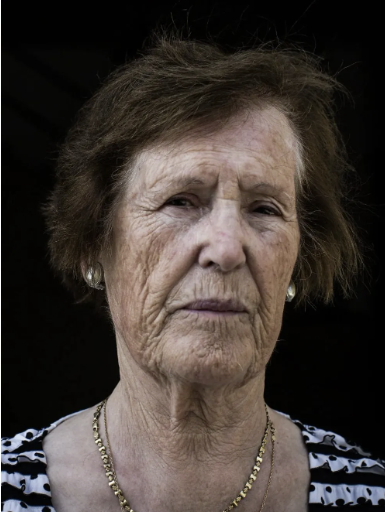
Cecilia Gimenez lived a struggling life. She was a widow in the small town of Borja, Spain. Her two sons, Jesús and Jose, were both born crippled. Jesús had muscular dystrophy and died at 20. Jose had cerebral palsy and needed his mother’s full-time care. Cecilia worked at a bar to bring in extra money.
To comfort herself, she volunteered at her church, the beautiful Sanctuary of the Pitiful Heart. She loved that church dearly. She was married there. Her boys received first communion there. But the centuries-old church didn’t have much money, so parishioners helped however they could.
Cecilia was a painter, and she painted where and when she could.
One day in August of 2012, the 81-year-old painter noticed the sorry state of the church’s fresco, Ecce Homo. Over time, salt and moisture from the aquifer beneath the church had deteriorated the painting until it looked like this. Without express permission, Cecilia decided to restore it herself. She had touched up the painting before, and the priest knew about that, but nothing quite like this.

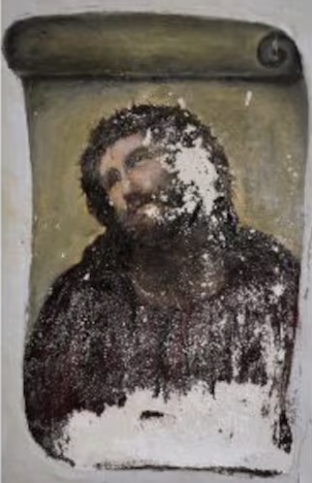

Mostly a painter of flowers, she had little experience with portraits. So she began with the tunic. Easy enough. Then came Jesus’ face, which proved far more difficult. She stopped, took a two-week holiday, and intended to return later to finish the work. But there was one slight problem: while she was away, the local art center discovered the restoration attempt. They informed the artist’s family. Together they raised a ruckus, and soon Cecilia’s unfinished work was all over the internet. And the internet did what only the internet can do: drag a stranger through the virtual mud without knowing the full story.

Memes were everywhere. The painting was dubbed Ecce Mono, or Monkey Christ. Art critics and strangers alike said awful things about her. Soon the media chased her through the streets. Utterly humiliated, she cried at home and refused to eat, losing 13 pounds in just days. Finally, overcome with despair, she was refined to her bed.
Such suffering when all she wanted was to serve God the best way she knew how. And she was ridiculed for it.
Maybe you know something about that. Maybe you’ve tried to help someone you love only to have your motives questioned. Maybe you poured yourself into your children and still wonder if you got it all wrong.
Maybe you volunteered, gave your time and talents, only to feel unnoticed or criticized. Maybe you tried to do the faithful thing, the loving thing, and instead of gratitude or joy, it brought exhaustion, conflict, embarrassment, or pain.
We expect our striving to be met with acceptance, maybe even glory. Yet so often it leaves us wounded instead. Oddly enough, according to Jesus, glory does not look like influence, success, or self-assertion. It looks like the cross. Jesus says, “I glorified you on earth by finishing the work that you gave me to do.” And that work was a life poured out in love for others. A cruciform glory, as one pastor calls is. Glory revealed not in grasping for power, but in service. Not in demanding our own way, but in sacrifice for another. Not in avoiding vulnerability, but entering into it out of love.
That kind of life often involves suffering, because it’s so opposite of the ways of this world. But suffering itself is not the glory. Love is. The glory is Christ revealed through mercy, service, sacrifice, and steadfastness. And somehow God brings resurrection out of places the world expects only humiliation or defeat.
Just ask Cecilia.
Shortly after being bedridden, flowers and a card arrived with some kind words. More followed. Then the visitors came to Borja, not to torture her, but to see the painting for themselves. Over 50,000 people came. Still today 15 to 20 thousand come annually. The church started charging three euros to enter. They set up a shop and sold Ecce Homo t-shirts, mugs, pencils, magnets, even wine. The money funded not only the church, but the nearby hospital for elderly folks who couldn’t afford care. Cecilia received money too, but when she felt she didn’t need any more she gave it to muscular-dystrophy charities in honor of her son Jesús.
Perhaps most miraculous, the perception that Cecilia wasn’t an artist changed. The family of the original artist decided not to restore the fresco, but keep Cecilia’s work. People and art critics began to take that work seriously, finding its simplicity moving, the work of a devoted believer who loved her church and simply wanted to offer something beautiful.
And maybe that was the glory all along. Not the mockery she endured online or in person. Not the fame that followed. But the quiet, cruciform beauty of someone who served without seeking recognition.
A widow caring for her disabled sons. An elderly woman painting church walls because she loved her congregation. A believer trying, however imperfectly, to honor Christ.
And somehow, out of that humble, some say botched, offering, God brought unexpected new life: care for the elderly, support for muscular dystrophy charities, renewed community, and a different kind of beauty for people to behold.
Cecilia died this past Christmas at 94. As C.S. Lewis once wrote, the promise of glory is the promise that because of Christ, we will please God.I am certain God said to her, “Well done, good and faithful servant.”
Glory is not found in wealth, fame, success, or a 1.5 trillion dollar military budget. Nor is it found merely in art and beauty themselves. Rather, glory is revealed in love poured out for another. Or, at least, that’s what I keep telling myself as Katelyn and I prepare to welcome baby number two any day now.
I know the sleepless nights, the poopy diapers, and the immense overstimulation headed my way will not look, feel, smell, or sound glorious. But somehow, even there, Christ and his glory are revealed through it all. Because it is love poured out for another.
And I believe the same is true for you and whatever your struggle, whatever your sacrifice, whatever service you are enduring and offering in your own life. Glory is not the opposite of any of that. Rather, in Christ and by his cross, God keeps bringing new life, mercy, and even glory out of what the rest of the world only sees as failure, exhaustion, or defeat.
In that way, we are all bound for glory. Thanks be to God.
Amen.


