Step by Step Series

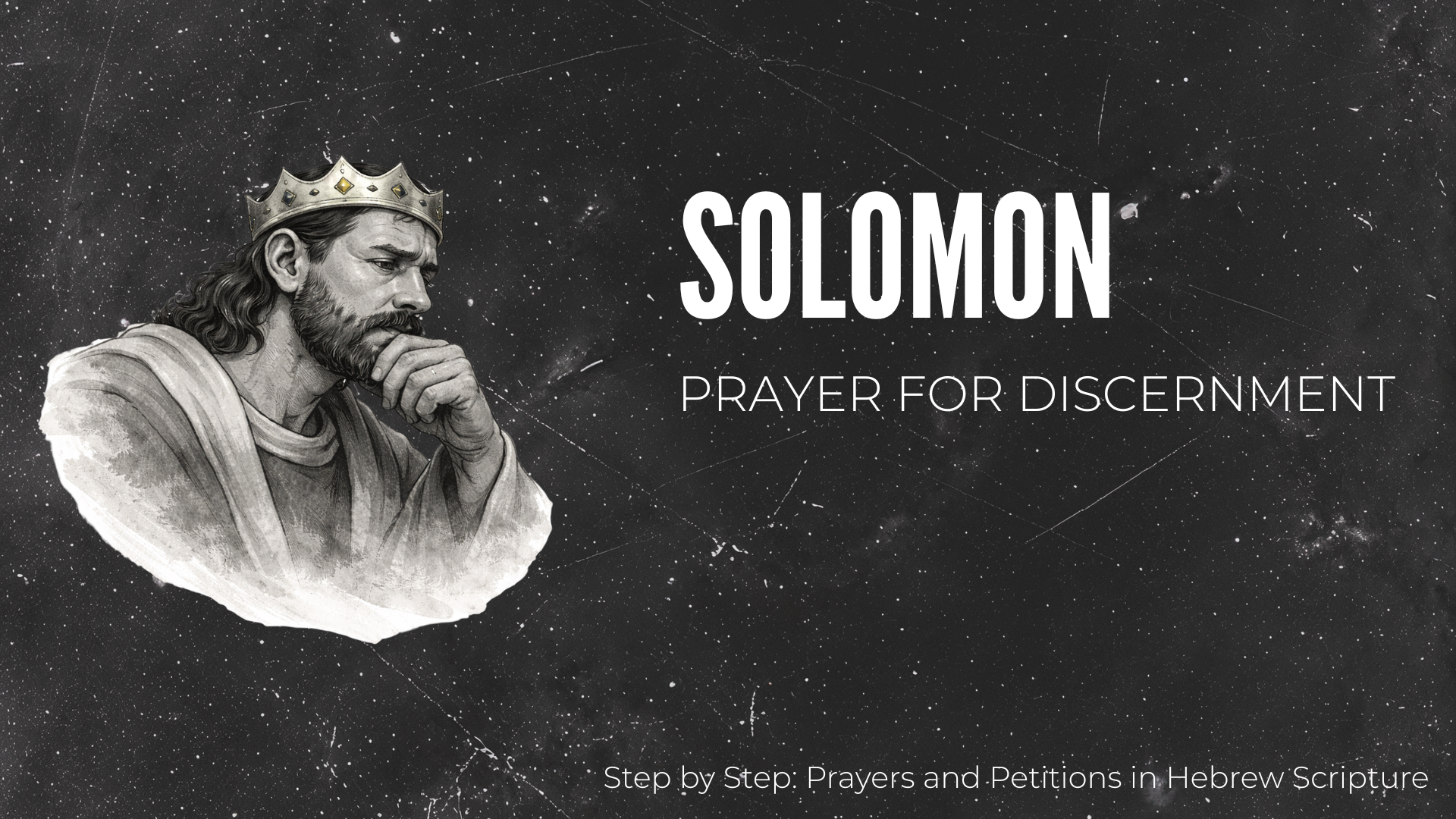
Solomon: Prayer for Discernment

1 Kings 3:4-14

The king went to Gibeon to sacrifice there, for that was the principal high place; Solomon used to offer a thousand burnt offerings on that altar. At Gibeon the Lord appeared to Solomon in a dream by night, and God said, “Ask what I should give you.” 

And Solomon said, “You have shown great and steadfast love to your servant my father David because he walked before you in faithfulness, in righteousness, and in uprightness of heart toward you, and you have kept for him this great and steadfast love and have given him a son to sit on his throne today. 

And now, O Lord my God, you have made your servant king in place of my father David, although I am only a little child; I do not know how to go out or come in. And your servant is in the midst of the people whom you have chosen, a great people so numerous they cannot be numbered or counted. 

Give your servant, therefore, an understanding mind to govern your people, able to discern between good and evil, for who can govern this great people of yours?”

It pleased the Lord that Solomon had asked this. God said to him, “Because you have asked this and have not asked for yourself long life or riches or for the life of your enemies but have asked for yourself understanding to discern what is right, I now do according to your word. Indeed, I give you a wise and discerning mind; no one like you has been before you, and no one like you shall arise after you. I give you also what you have not asked, both riches and honor all your life; no other king shall compare with you. 

If you will walk in my ways, keeping my statutes and my commandments, as your father David walked, then I will lengthen your life.”


Listen to your heart  when’s he’s calling for you. Listen to your heart, there’s nothing else you can do. I don’t know where you’re going and I don’t know why, but listen to your heart, before you tell him goodbye.
Yes, that’s Roxette’s 1988 power-ballad “Listen to Your Heart.” Be honest: how many of you wore out the cassette tape, belting it in the car? Songwriter Per Gessle says he wrote the tune after an all-night talk with his best friend whose marriage was crumbling. 

That pep-talk became a #1 hit, but here’s my problem with Per: catchy tune. Terrible advice; not only to his friend, but to the millions of people who listen to that song and think, “that’s how I’ll know what to do, I just need to listen to my heart.” 

The sentiment has become the go-to cliché for discernment. The motto sounds innocent enough, but its implications are anything but. “Listening to your heart” is really code for turning inward—figuring out what you want, what you think you need—and letting that be the deciding factor. 

We say it all the time in different ways: To the student choosing a major, study what makes you happy. 

To the friend considering a relationship, be with the one who makes you happy. To anyone eyeing a new city or job, go where you’ll be happy. With this Roxette wisdom, the most important person in the equation is you, and the measure of a good choice is whatever benefits you most. 

After all, as the song says, “there’s nothing else you can do.”

Except there is. Because sooner or later we realize that turning inward pulls us in a dozen directions. 

We don’t really know what we want; we misjudge what will make us happy—and we end up right back where we started, unsure what to do next. 

That’s the crossroads where Solomon stood, and his prayer flips the slogan on its head: discernment isn’t listening to your heart; it’s asking God for a listening heart, one attuned to God and to the people around you.

That request, a listening heart, is the heartbeat of this prayer. But notice how it starts. God says to the brand-new king, “Ask me for what I should give you.” Translation: Anything you want, Solomon - name it. Solomon responds with a little speech about how great God is and how faithful God was to his father David. 

It sounds a bit like a child buttering up a parent before the big ask: “Mom, you’re the best mom; can I have candy for breakfast?”

Solomon even calls himself “a little child who doesn’t know how to go out or come in.” Meaning, he has zero military experience; he doesn’t know how to lead an army out or bring one home—let alone guide a nation. That honesty is ironic, given how Solomon reached the throne.  

He wasn’t ushered in by popular acclaim like his father David; others were ahead of him. With some help, he muscled his way in, banishing rivals to far-off places, arranging a few convenient deaths. He rose less like an anointed king and more like a mafia boss. Now he admits he’s in over his head.

Solomon fought hard to reach the throne, only to realize he suddenly doesn’t know what to do. He could have made a candy-for-breakfast request—asking for the things kings usually crave: a long life, a larger kingdom, protection from rival nations. Had he turned inward and listened to his own heart, that’s likely what he would have asked for. But he doesn’t. Instead, he owns up to his limits and asks for help: “Give your servant an understanding mind to govern your people, able to discern between good and evil, for who can govern this great people of yours?” 

Understanding mind doesn’t quite get at the depth of the Hebrew. Solomon is literally asking for a listening heart. In the Old Testament world, the heart was the decision-making center where thought and passion met. Notice he isn’t asking for a good heart, but a listening one: attentive to the petitions of the people he now leads, tuned to God’s voice, able to choose between good and evil—between what brings life and what brings death.

This request almost seems surprising to God, who expected riches and long life and the death of enemies. But because Solomon did not ask for any of that, God gives the new king not only what he asked for, but also the very things he didn’t.

This is not a story telling us that if we butter God up just right and ask for the perfect thing, God will give it to us and then some. Rather, what I hope you see is that we have all been in something like Solomon’s position. Sure, you haven’t acted like the Godfather to get what you want—or at least I hope not. 

But all of us have found ourselves in a situation where others need us, depend on us, and we don’t know what to do. Maybe it’s something you’ve always wanted, something you’ve envisioned a thousand times, but once you finally arrived, you realized you had no idea what you were doing. Or perhaps you were thrust into a position you never wanted, and suddenly people are looking to you for help.

It’s the newly married couple with no idea what they’ve gotten themselves into. The new father who is overwhelmed with parenting. The person who just got a promotion—or a divorce, or a diagnosis, or a diploma—but has no idea what to do next.

What Solomon shows us is that rather than listen to your heart, we ask God for a listening heart: one that opens us to the needs of those around us, makes us aware of how our decisions affect others, and leads us to choose what brings life, not just for ourselves, but for all people. 

That’s true discernment. 

And that’s the prayer we carry with us tonight: God, give me a listening heart. In my home, in my work, in every place where others are depending on me. In those moments when I feel over my head and don’t know what to do, teach me to listen to you, and to those around me, so that what I choose leads to life.

Amen.


Hannah: Prayer for Justice

1 Samuel 2:1-10

Hannah prayed and said, “My heart exults in the Lord; my strength is exalted in my God. My mouth derides my enemies, because I rejoice in my victory.

“There is no Holy One like the Lord, no one besides you; there is no Rock like our God. Talk no more so very proudly, let not arrogance come from your mouth; for the Lord is a God of knowledge, and by him actions are weighed. The bows of the mighty are broken, but the feeble gird on strength. Those who were full have hired themselves out for bread, but those who were hungry are fat with spoil. The barren has borne seven, but she who has many children is forlorn. The Lord kills and brings to life; he brings down to Sheol and raises up. The Lord makes poor and makes rich; he brings low, he also exalts. He raises up the poor from the dust; he lifts the needy from the ash heap, to make them sit with princes and inherit a seat of honor. For the pillars of the earth are the Lord’s, and on them he has set the world.

“He will guard the feet of his faithful ones, but the wicked shall be cut off in darkness; for not by might does one prevail. The Lord! His adversaries shall be shattered; the Most High will thunder in heaven. The Lord will judge the ends of the earth; he will give strength to his king, and exalt the power of his anointed.”


It wasn’t intentional that we saved Hannah’s prayer for the week of International Women’s Day, which was this past Sunday, but sometimes happy, holy accidents just happen. So it’s good and right that we hear a prayer for justice from one of our ancestors – a woman – who prays a beautiful, bold, faithful, full-throated appeal like what we just heard; and another, which we’ll hear shortly.

Hannah, we know, was the mother of the prophet Samuel. And it’s knowing that Hannah was one of two wives to a guy named Elkanah. Elkanah’s other wife was a baby-making machine – she had sons and daughters aplenty, though we don’t know how many. And Elkanah’s other wife, described as Hannah’s “rival,” was terrible about it. According to the story, she “provoked” and “irritated” Hannah, which I imagine means she mocked her and made fun of her and shamed her for not being able to have children as easily or as prolifically as she could.

And, as Pastor Cogan reminded us on Sunday, in teaching about that un-named woman at the well who’d had five husbands by the time she met up with Jesus, having children – back in the day – was confirmation of your worth as a woman; it assured your status and place in a family; it was a very practical source of security (you’d have people to protect and provide for you, should you ever be widowed or alone); it was how you mattered as a woman in a misogynistic, patriarchal, man’s world.

So Hannah may have wanted a child because her mothering instincts were in full effect. She may also have wanted a baby because she wanted to make her husband happy. (The Bible tells us that Elkanah loved Hannah, in spite of the fact that she hadn’t given him a child, yet.) But Hannah may have wanted a child – and a boy, in particular – simply because she longed for affirmation of her worth, of her value, of her esteem, in her own eyes, in the eyes of God, in the eyes of the world … and maybe so she could tell that “sister wife” of hers … Elkanah’s other wife … to take a hike – or something similar.

That’s why Hannah prayed to and bargained so intensely with God. She promised she would commit her baby boy to a life of sacrifice and service to the Lord. And then it happened. God delivered. And Hannah delivered. And she kept her promise, too. She loved, cared for, fed and nurtured her little boy Samuel until she handed him over to the Lord; to live in the house of the high priest, Eli, and to become one of the greatest prophets in all of Israel’s history.

And Hannah’s prayer for justice that we heard was prayed in celebration and with thanksgiving for God’s answered prayer … for the gift of her baby boy. And Hannah’s song sounds like the original to the Virgin Mary’s cover version, so many generations later, in the Gospel of Luke – the Magnificat – which gets a whole lot more air-time because … Jesus.

See, in Hannah’s song, her heart “exults in the Lord,” she “smiles at her enemies” because she “rejoices in God’s salvation.” Likewise, Mary’s soul “magnifies the Lord” and her spirit “rejoices in God her savior.”

Hannah says, “the bows of the mighty are broken,” and “the feeble gird on strength.” Mary says “the mighty are cast down from their thrones” and “the humble in heart are lifted up.”

For Hannah, “Those who were full have hired themselves out for bread, but those who were hungry are fat with spoil.” Mary says the same, just more simply, “God has filled the hungry with good things.”

You get the picture.

The undeniable similarities between Hannah’s prayer, like Mary’s, show a profound theological understanding about our God. A God who treasures and cares for the least among us. A God who protects the vulnerable and who challenges the powers that be. A God who listens to and uses the least likely suspects to bring justice, to provoke peace, to proclaim grace, to practice mercy, to do hard, holy, brave, beautiful things for the sake of the Kingdom.

Of course, justice of all sorts is worth praying about and working for in the world today. And since, as Martin Luther King, Jr. said, “injustice anywhere is a threat to justice everywhere,” because it’s International Women’s Month, and in honor of our ancestor Hannah, I found some things we could pray about, very specifically, where justice for women is concerned, and that impacts us all – or should:

• Did you know that every year more than 2 million girls are subjected to female, genital mutilation?

• Also, every year, 12 million girls in the world are married before their 18th birthday.

• 3.9 billion women live in countries with at least one law restricting their economic opportunities or access to the same justice as men.

• 90% of the world’s current billionaires were born before women could even get a line of credit.

• In the US, women get paid something like only 81-85% of what men do.

• Still, 6 in 10 Gen Z men believe/agree that we – men – are being expected to do too much to support gender equality. (For what it’s worth 4 in 10 Gen Z women believe the same.)

So, not only is there plenty to pray about because there’s plenty to be mad about, too. Which brings me to my last point for tonight. And that is the righteous anger I hear in the spirit of Hannah’s prayer, as much as all the rest. It’s what I hear when she prays that the lord “cuts off the wicked,” “shatters the adversaries,” and “thunders in heaven,” too.

So, I’ve asked Mallory to read again … something I’m taking liberties to call a modern-day protest prayer – not for babies, or for value that’s found in men’s approval, or for worth by way of society’s unfair standards – but a prayer for freedom and justice, generally, for women. It’s a poem by the play write and feminist Eve Ensler. (You might remember her as the creator of “The Vagina Monologues” from back in the day.) This is a slightly abridged piece, minimally edited for content that’s safe for worship.

I Am Leaving My Father’s House by Eve Ensler

I am leaving my father's house.

Stepping out, stepping off, free falling outside the confines of what is acceptable and known.

I am leaving this cage which suppressed me, depressed me, made less of me so thoroughly I came to call it my legacy, my country, my home.

I am leaving those angry men whose broken hearts and wounds became more painful and urgent than my own.

I'm not going to be sorry anymore or responsible or wrong.

I'm going to stop believing I can wake you up or break open your shell or get you to feel your grief, your tenderness.

I'm going to stop mainlining my life force into your self-esteem.

Air pump girl blowing up boy rubber ball. You can stay flat and go nowhere by yourself.

I am leaving my father's house.

I'm not going to whisper anymore or tiptoe or lay flat on my back.

I'm not ducking, flinching, waiting till you finish or whimpering in the dark.

I am moving out. I'm not going back.

I am leaving my father's house.

Because I no longer believe your lies about freedom and democracy – that it hurts you more than your whips or words or policies hurt me.

I'm going to believe what I see: bruises on my neck, Iraqi women with their voting fingers chopped off, emaciated polar bears in the Arctic melting from corporate greed.

I'm fleeing your disguised terror of my bigness, my hunger, my vagina, my tongue.

I am leaving my father's house.

I don't want a position there.

I'm not going to leash your prisoners.

I'm not going to starve your workers, organize your lynch mobs, or camouflage your crimes.

I'm not going to be a trophy on your arm or smile till my face breaks off.

I am leaving my father's house.

Corporate towers, cathedrals, mosques, and synagogues, picket fence houses and pentagons.

I'm going out.

Past the neighborhoods, past nations, fundamental doctrines and misinterpreted laws, past the reach of your fist, past the fire breath of your rage, past the tentacles of your seductive melancholy or your unspoken promises to change. I am willing to be alone, disliked, slandered, and misconstrued, because my freedom is more important than your so-called love.

Because my leaping will be the ultimate jumping off, will be the new beginning where we all get to start without a daddy in charge, on top, in control of all the goods, ideas, interpretations, and cash.

I'm going out there by myself.

But I know I will find the rest of you there waiting, ready, knee deep in the garden, hands raised in the water, way, way out past my father's house.

So, many thanks to Hannah tonight for her patient faithfulness, for her selfless sacrifice, for her powerful proclamation;

…for professing her faith, for promising justice, for proclaiming hope;

…for pronouncing God’s good news, mercy, abundance;

…and for her righteous anger, too, that should stoke and give permission for our own.

May we all pray in similar ways … for us and for others … until “the moral arc of the universe,” as the saying goes, “bends towards justice” … until righteousness and peace kiss one another … and until all of God’s people – men, women, and everyone in between – a re found ready, waiting, and knee deep in the garden, hands raised in the water, and moved beyond the house of the world’s patriarchy.

Amen

(The “Not Safe for Worship” version of Eve Ensler’s poem can be watched below.)